A World Rewriting Its Rules
A trilateral meeting of the presidents of the United States, China and Russia is scheduled for November 19, 2026, in Shenzhen, China, according to an official announcement by China’s Ministry of Foreign Affairs on November 16, 2026. The announcement confirms the planned meeting, not that it has already taken place or what it may achieve. Regardless of its outcome, the more important question is whether the structure of global economic power is already changing.
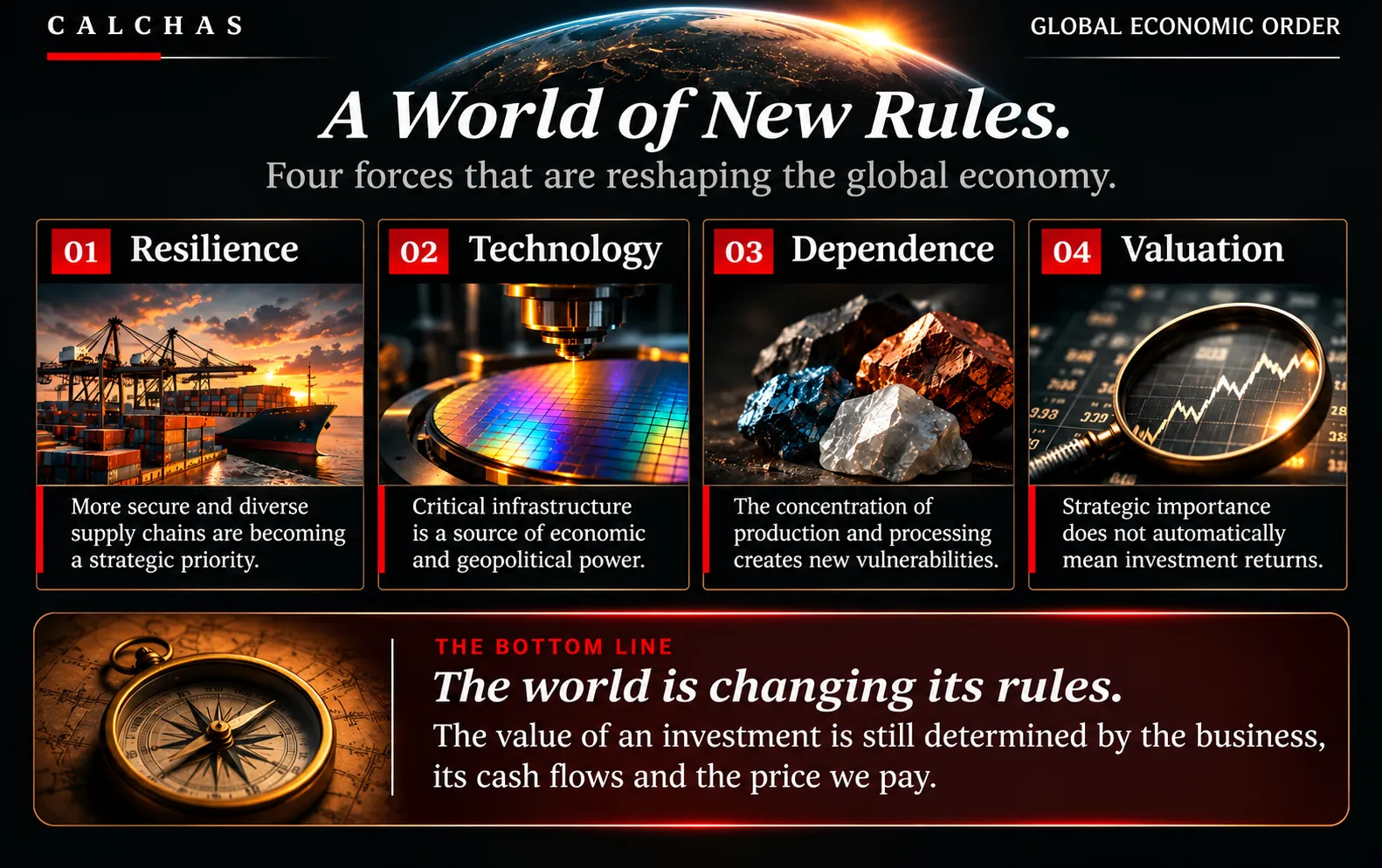
The answer is yes. Not because globalization is coming to an end, but because economic efficiency is no longer the sole consideration behind major decisions. Supply-chain security, access to critical technologies, energy resilience and strategic autonomy are becoming increasingly important. For long-term investors, the consequences lie in business competitiveness, cash flows and intrinsic value.
01 / From Efficiency to Resilience
For decades, businesses sought the most efficient production locations, relied on international suppliers and expanded into new markets. This model delivered substantial benefits through specialization and economies of scale. It also exposed vulnerabilities when critical components or customers were concentrated in a few locations.
Governments and companies are increasingly willing to accept some additional cost to reduce critical dependencies. This is not a uniform retreat from globalization. The WTO reports that the gap between trade within and across its analytically defined geopolitical blocs narrowed during 2025 and early 2026. These blocs are hypothetical groupings inferred from United Nations voting patterns, not formal alliances.
US–China economic decoupling accelerated in 2025, although bilateral trade appeared to stabilize marginally in 2026. The global economy remains interconnected. What is changing are the terms of that interdependence.

02 / The Cost of Economic Security
Building new factories, diversifying suppliers and maintaining alternative capacity require capital. In a hypothetical scenario of geopolitical fragmentation examined in the WTO’s World Trade Report 2026, global real GDP in 2050 would be 5.1% lower and global exports 18.6% lower than in the baseline. These are scenario outcomes, not near-term forecasts.
The consequences are uneven. Businesses with pricing power may absorb or pass on higher costs; others may face lower margins. New capacity can improve resilience while reducing returns on invested capital. Greater economic security does not necessarily mean greater profitability.
03 / The Changing Geography of Economic Power
The United States combines technological innovation, deep capital markets and the dollar’s international role. China has a broad industrial base and an important position across supply chains. Russia plays a smaller role in global merchandise trade, with particular influence through energy and raw materials.
According to WTO figures for 2025, Russia accounted for 1.6% of global merchandise exports, versus 14.4% for China and 8.3% for the United States. According to the Bank of Finland, Russia–China trade declined in 2025 but increased by more than 20% in value in the first half of 2026. The value of China’s Russian oil imports rose by approximately 30%, versus around 17% in volume, showing the influence of prices.
The European Union, India, Japan, South Korea and other economies also shape the emerging order. It cannot be understood solely through three capitals.
04 / The Infrastructure of Strategic Power
Semiconductors and artificial intelligence. Advanced chips depend on internationally distributed design, equipment, materials and expertise. WTO figures indicate that trade in AI-enabling goods increased by 67% year on year in value in the first half of 2026. These goods represented 14.8% of merchandise trade and 47% of its growth. The figures are in current US dollars and reflect prices as well as quantities.

Energy. The IEA estimates that data-center electricity use could rise from roughly 485 TWh in 2025 to 950 TWh in 2030, approximately 3% of global electricity demand. Grid capacity, construction delays and capital requirements matter as much as headline demand.
Critical minerals. China accounts for approximately three-quarters of lithium processing (74%) and cobalt processing (76%), 94% of battery graphite processing and 47% of copper refining, according to the IEA figures summarized by BOFIT. These are processing shares, not mining shares. New processing facilities require time and investment.
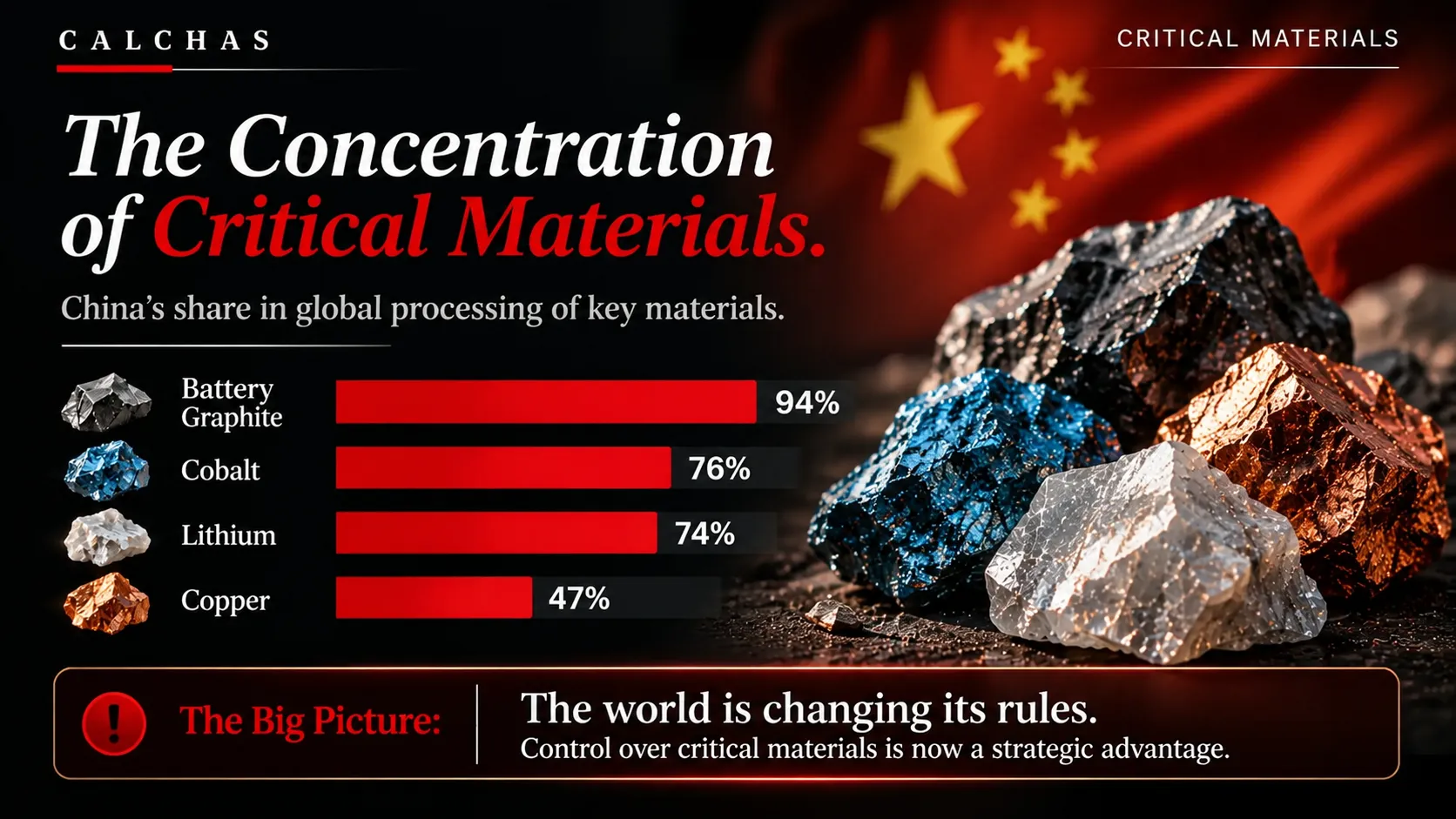
Critical minerals often make up a relatively small share of the final product’s cost. Some diversification costs may therefore be absorbed with limited consumer-price effects, while intermediate industries face more pressure. For investors, the key question is where costs accumulate and who must bear them. A mineral deposit is not the same as industrial independence.
05 / Three Possible Paths
Gradual accommodation: major powers continue to compete but ease selected restrictions. Watch for changes in trade rules and cross-border investment.
Managed competition: trade continues, while strategic sectors remain subject to tighter controls. Watch for selective restrictions and manufacturing relocation.
Deeper fragmentation: restrictions expand and firms build increasingly separate networks. Watch for wider export bans, sanctions and sustained declines in trade flows. These scenarios may coexist across different industries.
06 / What This Means for Long-Term Investors
A semiconductor-equipment company may benefit from new factories in several regions, yet remain exposed to a handful of customers, export controls or postponed capital spending. Investors need to examine concentration, competitive advantage, recurring service revenue and valuation.
An energy-infrastructure company may report growing orders and a large backlog, yet require substantial upfront spending, debt or share issuance. Orders are not free cash flow, and revenue growth does not guarantee per-share value creation.
An industry’s strategic importance is not the same as the investment attractiveness of its stocks. Start with the business, its advantage and its economics; only then assess valuation and the margin of safety.
07 / What to Watch
The officially scheduled trilateral meeting on November 19 may offer diplomatic signals, but statements must be distinguished from implemented policy. Monitor US–China trade and technology rules, energy dependencies, critical processing capacity and returns on new infrastructure.
One specific checkpoint is January 10, 2027: the announced suspension of certain newer Chinese rare-earth export restrictions runs until that date, while older controls introduced in April 2025 remain in force. A further extension, relaxation or reinstatement could affect supply chains. What matters is enforcement and economic impact, not the announcement alone.
Sources
- WTO — Global Trade Outlook and Statistics (October 2026)
- WTO — World Trade Report 2026
- IEA — Key Questions on Energy and AI
- IEA — Global Critical Minerals Outlook 2026
- BOFIT — Russia–China Trade
- BOFIT — Critical Minerals
- S&P Global — Rare Earth Export Controls
- China Ministry of Foreign Affairs — Official summit announcement (16 November 2026)