
01 / The Paradox of Patience
In most human endeavours, effort is linked to results. The harder we work, the more we expect to achieve.
In investing, that relationship does not always hold.
An investor may spend hours each day monitoring markets, execute dozens of trades and ultimately earn lower returns than someone who makes only a handful of carefully considered decisions.
The opposite can also happen. An investor may spend years waiting for the ideal opportunity, watching exceptional businesses grow without ever acquiring a stake in them.
In both cases, the problem is not necessarily a lack of knowledge, but an inability to distinguish when to act from when to wait.
Investment patience takes three distinct forms:
- Before investing, when we seek an attractive opportunity.
- After investing, when we allow the business to create value.
- When circumstances change, as we try to distinguish temporary difficulties from permanent deterioration.
At none of these stages is patience an advantage in itself. It becomes valuable when grounded in research, an understanding of the business and a rational assessment of risk.
The aim is not to wait longer. It is to wait for the right reasons.
02 / The Illusion of Productivity
The stock market offers a constant stream of stimuli: changing prices, news, economic forecasts, emerging technologies and opinions from people who appear certain about the future.
In this environment, inactivity can leave investors feeling that they are not doing enough.
Academic research, however, offers a different perspective.
In 2000, Brad Barber and Terrance Odean published Trading Is Hazardous to Your Wealth in The Journal of Finance. They examined the investment behaviour of 66,465 US households with accounts at a large American discount brokerage firm between 1991 and 1996. [1]
Trading Activity and Investment Returns
| Annualised geometric returns, 1991–1996 | Return |
|---|---|
| Least active households | 18.5% |
| Market benchmark | 17.9% |
| Average household — net of costs | 16.4% |
| Most active households | 11.4% |
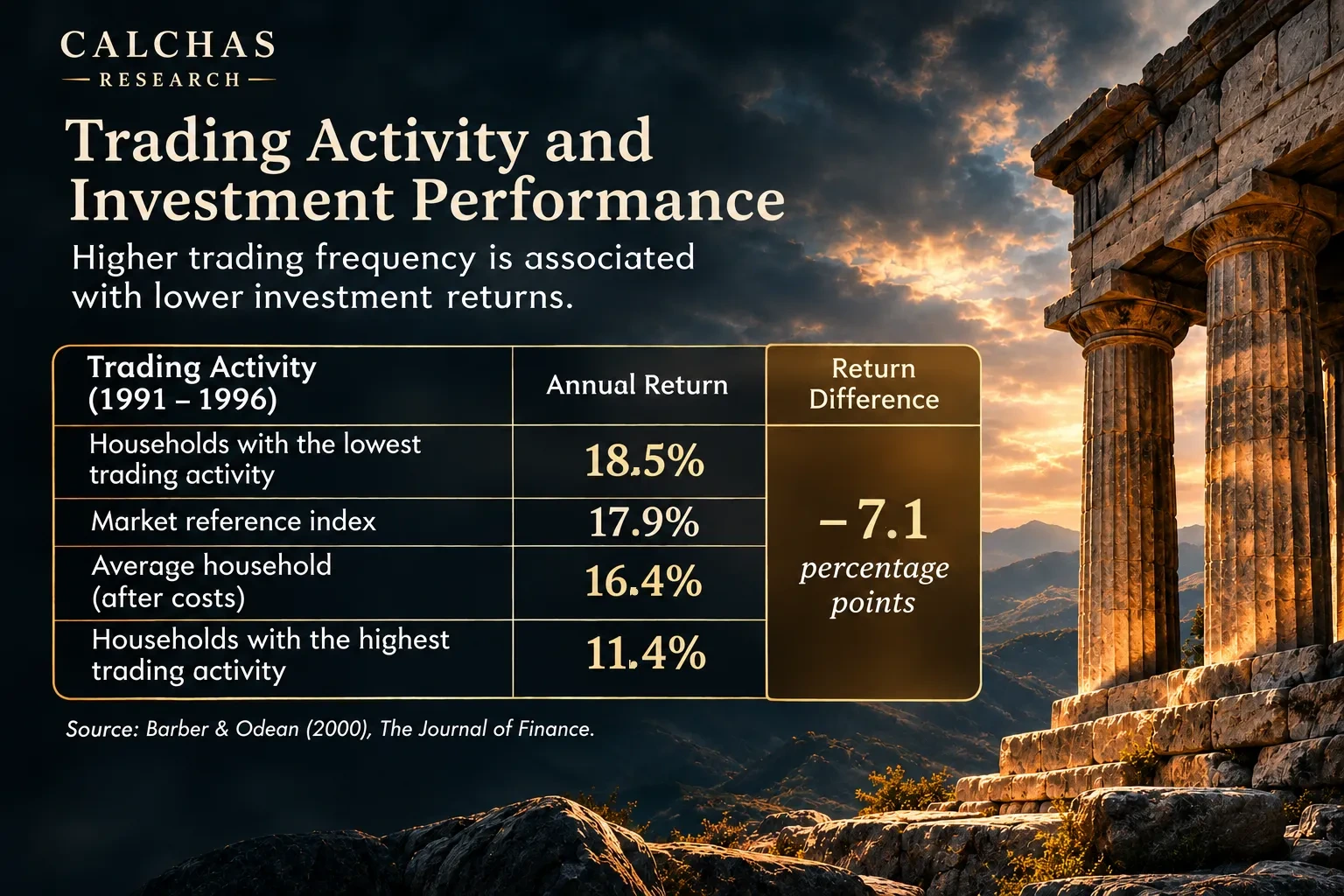
Source: Barber & Odean, The Journal of Finance, 2000. Household returns are net of transaction costs; the market benchmark excludes transaction costs.
The average household's return fell from 18.7% before transaction costs to 16.4% after costs. The most active traders earned an annualised net return of just 11.4%, compared with 18.5% for the least active traders.
Transaction costs include commissions and the difference between buying and selling prices (the bid-ask spread).
The researchers link these results to the cost of excessive trading and identify overconfidence as a possible explanation for such behaviour.
Transaction costs at the time differed from those of today. Moreover, the study does not establish that every active investment strategy fails.
From 2000 to the Modern Investment Landscape
The substantial reduction in trading costs and the rise of digital investment platforms have transformed the environment in which individual investors operate.
In 2022, Brad Barber, Xing Huang, Terrance Odean and Christopher Schwarz published a new study in the Journal of Finance, examining the investment behaviour of Robinhood users. The researchers found that users of the platform were more inclined to trade in response to attention-grabbing stimuli. Stocks attracting the most intense buying activity each day subsequently recorded average abnormal returns of −4.7% over a 20-day period, relative to the expected returns estimated by the study's model. [6]
The two studies examine different aspects of investment behaviour, and their figures are not directly comparable. Nevertheless, the more recent research highlights that easier access to financial markets and lower trading costs do not eliminate the risks associated with impulsive investment behaviour.
It does, however, highlight an important principle: the frequency of decisions is no measure of their quality.
Research, observation and preparation are meaningful investment work, even when they do not result in a trade.
03 / Warren Buffett and Charlie Munger — The Art of Waiting
Warren Buffett and Charlie Munger built Berkshire Hathaway around a philosophy that does not require constant trading.
Their approach rests on identifying businesses they understand, assessing their economic value and allocating capital when conditions are favourable.
Munger's contribution was pivotal.
As Buffett explains in Berkshire's 2023 letter to shareholders, Munger encouraged him as early as 1965 to place greater emphasis on business quality rather than focusing exclusively on a low purchase price. [2]
The search for a mediocre business at an exceptionally low price gradually gave way to the search for an exceptional business at a reasonable price.
In the former case, returns depend largely on the correction of a mispricing. In the latter, they can arise from the continued creation of economic value.
Time is not equally valuable to every business.
The Coca-Cola Case
In August 1994, Berkshire completed the purchase of its stake in Coca-Cola, a process that had taken seven years.
The total cost was $1.3 billion. [3]
| Berkshire Hathaway / Coca-Cola | Amount |
|---|---|
| Total acquisition cost | $1.3 billion |
| Market value at year-end 2022 | $25 billion |
| Annual dividends in 1994 | $75 million |
| Annual dividends in 2022 | $704 million |
| Growth multiple of annual dividends | 9.39× |
| Compound annual dividend growth | 8.3% |
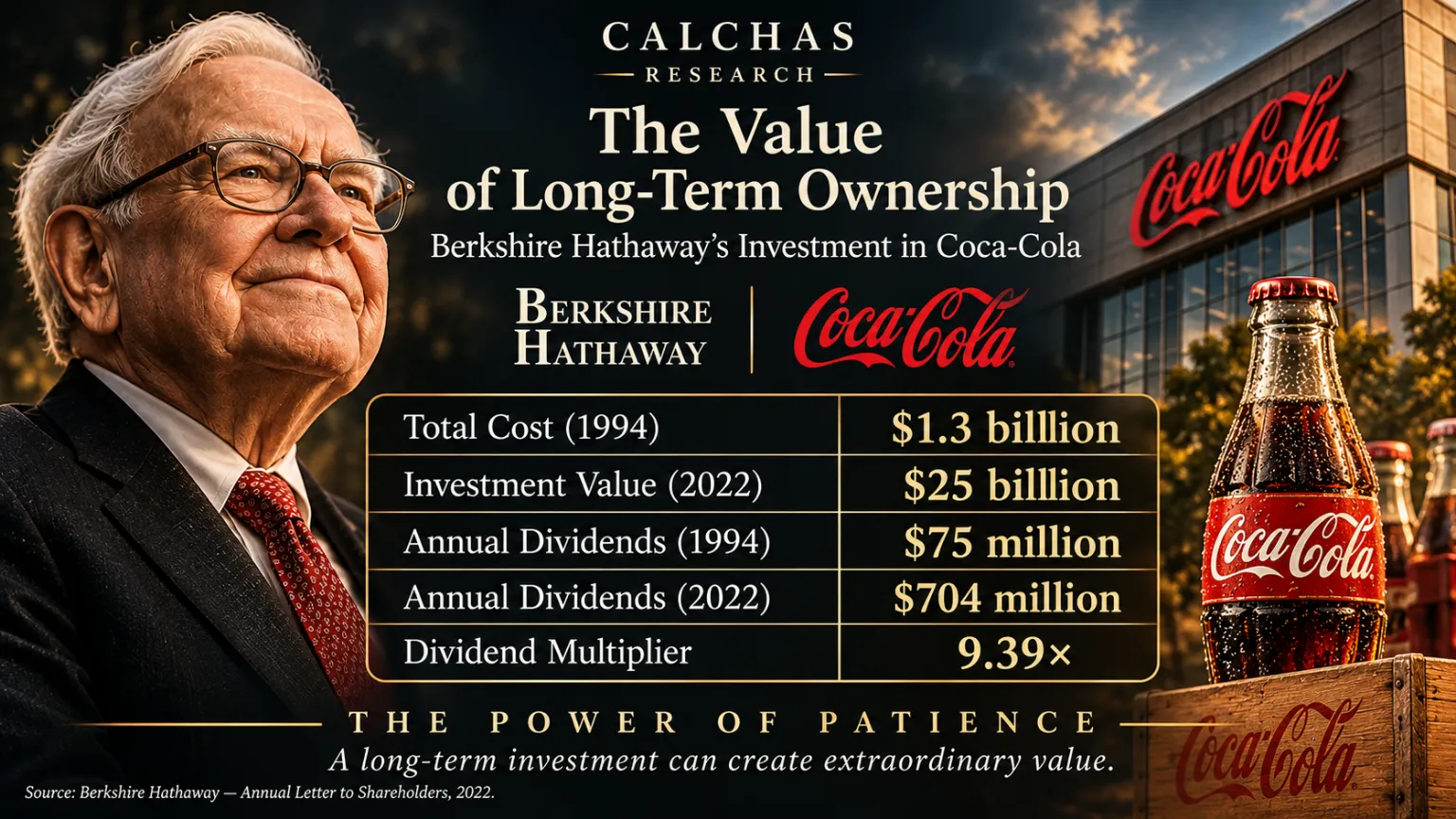
Source: Berkshire Hathaway, 2022 annual letter. CALCHAS calculations.
Berkshire did not need to predict the stock's daily movements. It needed to understand the economic strength of the business and remain invested.
The example illustrates how a business can increase the cash flows it distributes to shareholders without requiring them to make further investments.
Coca-Cola is, of course, a successful historical example, not proof that every long-term holding will be rewarded. Some businesses gradually lose their competitive advantages and destroy economic value.
Long-term ownership remains justified as long as the fundamentals of the business continue to support the investment thesis.
04 / Benjamin Graham and Seth Klarman — Protecting Capital
For Benjamin Graham, the distinction between price and value is fundamental to the investment process.
The margin of safety acknowledges that even careful analysis can prove wrong. [4]
Businesses encounter unexpected difficulties, forecasts fail and competitive advantages can erode. The price an investor pays must account for this uncertainty.
Seth Klarman develops this philosophy further in Margin of Safety, placing particular emphasis on the risk of permanent capital loss. [5]
From this perspective, holding cash can be a deliberate investment choice. It allows investors to avoid investments that fail to meet their criteria and preserves their ability to pursue future opportunities.
The Asymmetric Mathematics of Loss
| Initial loss | Required recovery |
|---|---|
| −10% | +11.1% |
| −20% | +25% |
| −30% | +42.9% |
| −50% | +100% |
| −70% | +233.3% |
| −90% | +900% |
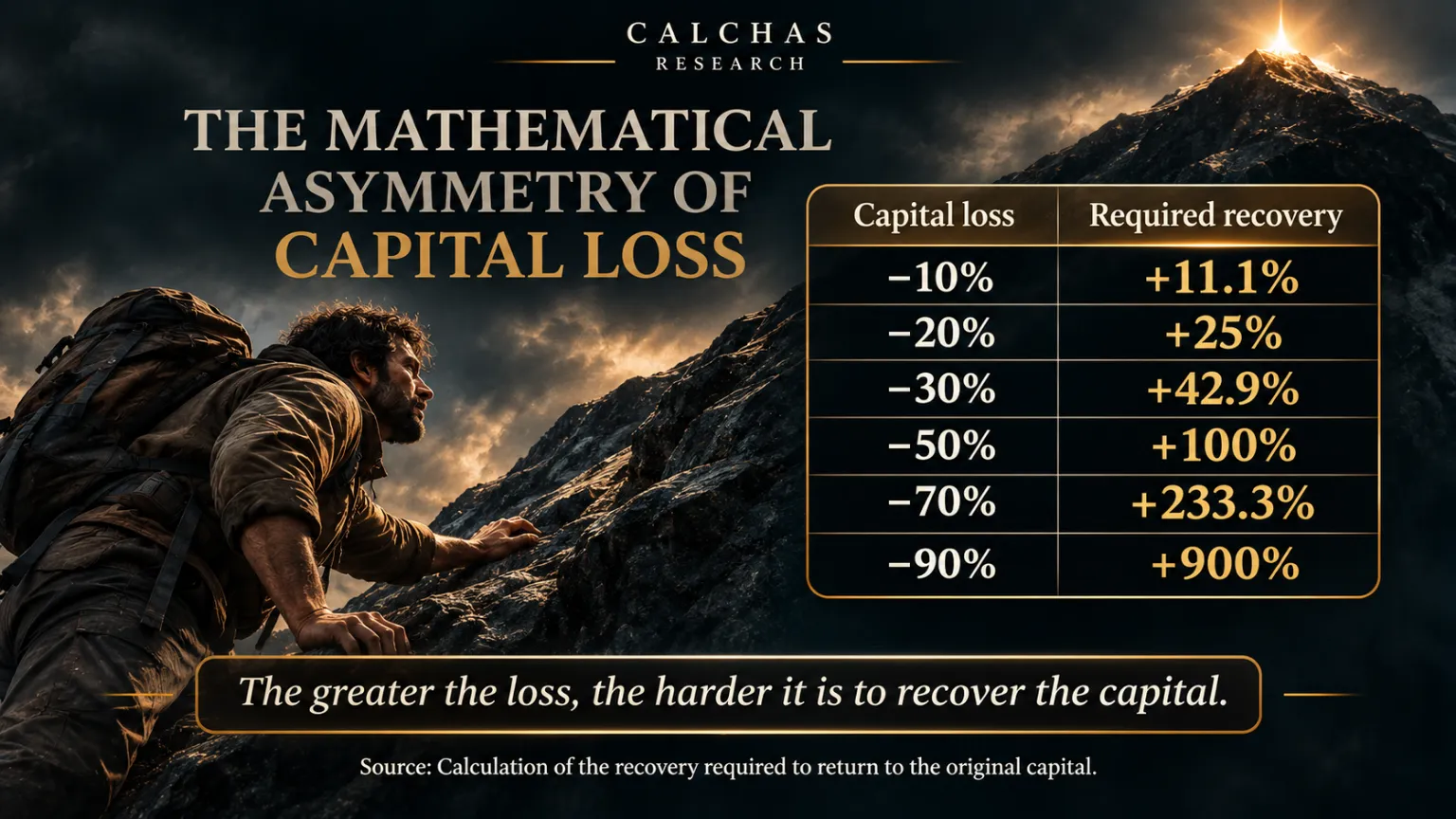
Initial capital: €10,000 → 50% loss: €5,000 → 100% recovery: €10,000.
Mathematical illustration of recovering initial capital, without additional deposits or withdrawals.
A 50% loss requires a 100% return to recover the original capital in full.
A temporary decline in a share price is, of course, not the same as permanent destruction of economic value. A healthy business may recover, while a business that has permanently lost its economic strength may never regain its former value.
It is equally important not to confuse a margin of safety with a demand for absolute certainty.
Every investment involves uncertainty. If we insist that it disappear entirely before investing, we may find that the opportunity has already disappeared.
05 / Waiting as Investment Work
Investment patience does not mean remaining indifferent to developments.
The waiting period offers time to deepen our understanding of businesses, study competitors, assess management and revise estimates of intrinsic value.
When the market presents an attractive opportunity, that preparation can prove decisive.
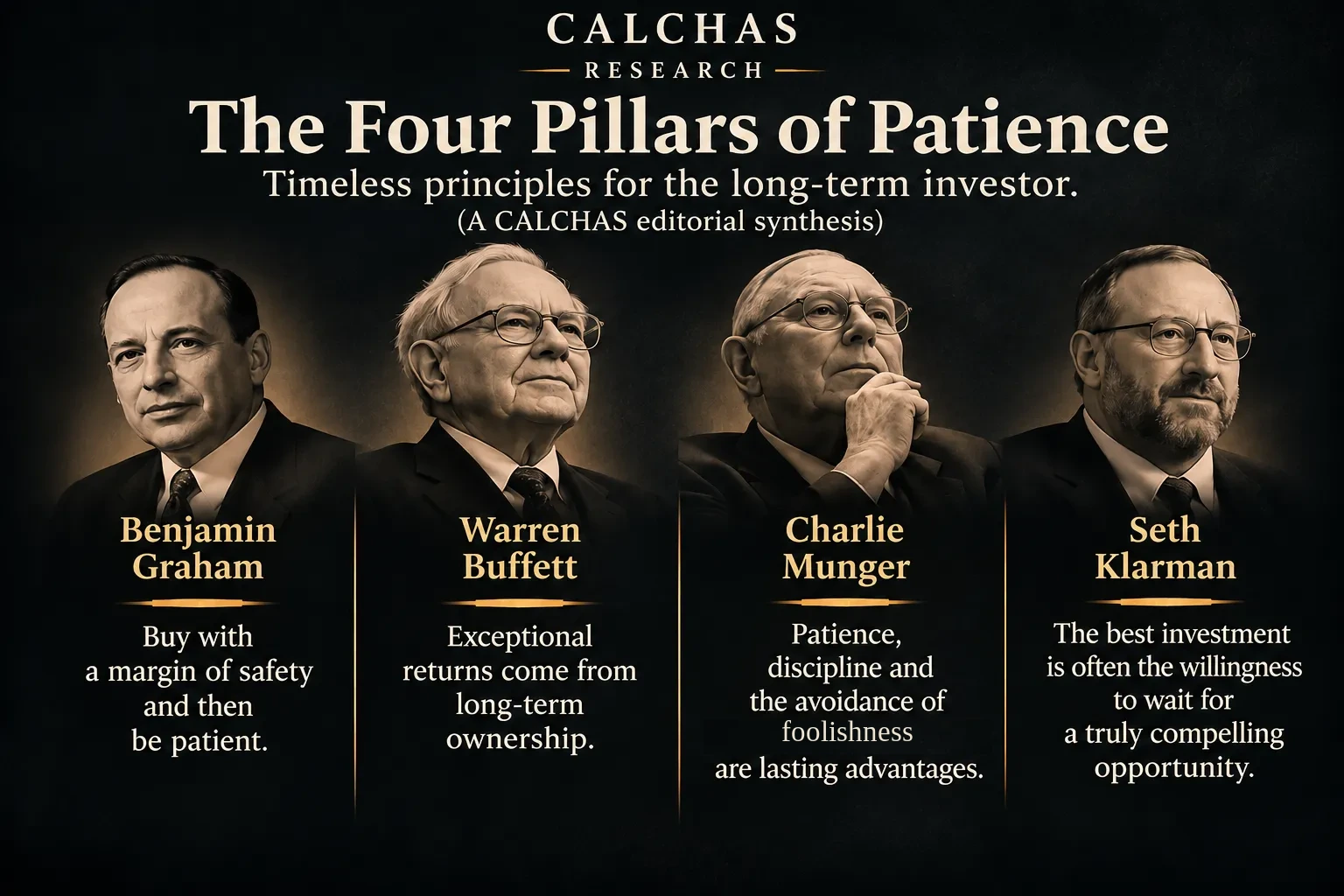
Buffett and Munger share a common investment philosophy, but each highlights a different aspect of it. Together with Graham and Klarman, they offer four complementary principles.
The Four Foundations of Waiting
01 / Value — Benjamin Graham
Distinguishing a stock's price from the economic value of the business.
02 / Selectivity — Warren Buffett
Selecting investments without feeling obliged to deploy capital continuously.
03 / Quality — Charlie Munger
Identifying businesses where time can work in the investor's favour.
04 / Protection — Seth Klarman
Preserving sufficient room for error in our assessment.
CALCHAS editorial synthesis. These formulations are not direct quotations from the investors.
These principles do not remove the need to make decisions. They help us prepare for them.
Ultimately, the quality of our waiting is judged by the quality of the decision that follows.
06 / The CALCHAS Conclusion
Daily market activity can create the impression that every day calls for a new investment decision.
Long-term investors can move at a different pace. They can devote time to understanding businesses, reject opportunities that do not meet their criteria and allow sound choices to bear fruit.
Capital preservation, business quality and valuation discipline are the foundations of this approach.
Yet one crucial question remains.
What happens when waiting lasts too long? When businesses continue to create value while investors remain fixated on finding the ideal price?
Waiting also carries an economic cost.
We will examine that cost in the second part of this series.
Patience Is Not Inaction.
It is the discipline to wait without being afraid to act.
ITHACA IS NOT ONLY THE DESTINATION. IT IS ALSO THE JOURNEY.
The Art of Investment Patience
I — Patience Is Not Inaction. The Discipline of Waiting
— Current articleII — The Cost of Waiting. When Investment Discipline Turns into a Missed Opportunity
— Coming soonIII — The Moment of Decision. When Waiting Must End
— Coming soonSources and Bibliography
- [1] Barber, B. M. & Odean, T. (2000). Trading Is Hazardous to Your Wealth: The Common Stock Investment Performance of Individual Investors. The Journal of Finance, 55(2), 773–806. https://doi.org/10.1111/0022-1082.00226
- [2] Berkshire Hathaway (2023). Annual Letter to Shareholders. Charlie Munger – The Architect of Berkshire Hathaway. https://www.berkshirehathaway.com/letters/2023ltr.pdf
- [3] Berkshire Hathaway (2022). Annual Letter to Shareholders. Long-term holdings and Coca-Cola dividends. https://www.berkshirehathaway.com/letters/2022ltr.pdf
- [4] Graham, B. (2003). The Intelligent Investor. Revised edition with commentary by Jason Zweig. HarperBusiness Essentials, Chapter 20: “Margin of Safety” as the Central Concept of Investment. First published in 1949. See also: Graham, B. & Dodd, D. L. (1934). Security Analysis: Principles and Technique. 1st edition, Whittlesey House / McGraw-Hill.
- [5] Klarman, S. A. (1991). Margin of Safety: Risk-Averse Value Investing Strategies for the Thoughtful Investor. 1st edition, HarperBusiness, Chapter 6: Value Investing: The Importance of a Margin of Safety, pp. 87–104.
- [6] Barber, B. M., Huang, X., Odean, T. & Schwarz, C. (2022). Attention-Induced Trading and Returns: Evidence from Robinhood Users. The Journal of Finance, 77(6), 3141–3190. https://doi.org/10.1111/jofi.13183
Disclaimer
This article is for informational and educational purposes only. It does not constitute personalised investment advice or a recommendation to buy or sell financial instruments.
References to specific businesses and investors are used to illustrate historical examples and investment principles. All investments involve risk, including the potential loss of capital. Past performance does not guarantee future results.