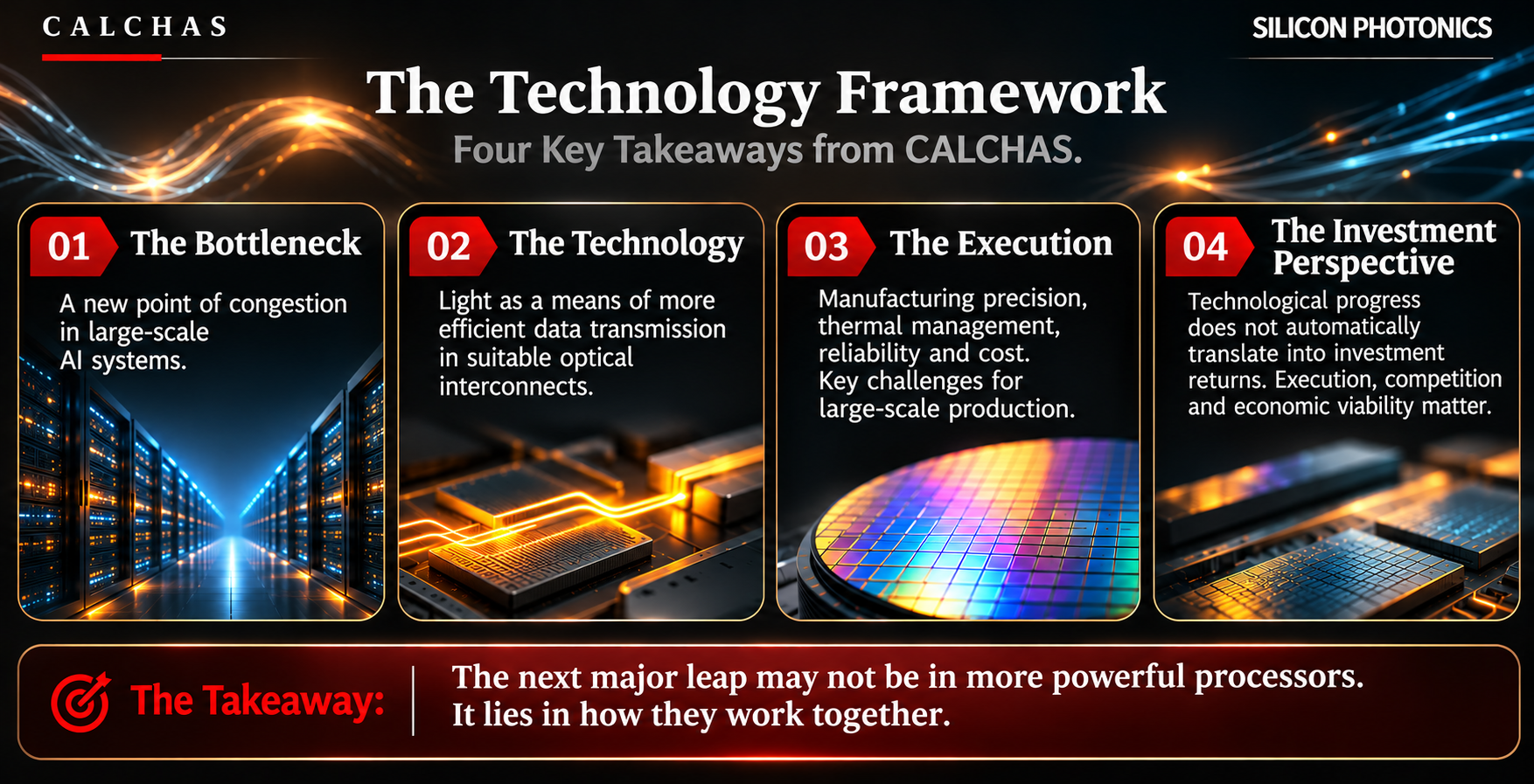
01 / The Problem We Don’t See
When we think about artificial intelligence, we usually think about powerful processors. Chips capable of performing billions of calculations, allowing AI systems to understand questions, generate content, and solve complex problems.
But the reality is more complicated.
The largest AI systems do not rely on a single processor. They use thousands of processors working together.
And to work together, they need to communicate.
Imagine a city filled with thousands of factories. Each factory has extraordinarily fast machines. Production keeps increasing.
But there is a problem.
The roads connecting those factories cannot transport goods quickly enough.
No matter how much the machines improve, the city's overall production will remain constrained by its transportation network.
Something similar happens inside large AI systems.
Processors are becoming more powerful. The need to transfer data is growing. And communication between processors is becoming increasingly important.
A system's performance depends not only on how quickly its components calculate, but also on how efficiently they work together.
02 / When Information Travels Through Light
Today, computers use electrical signals to transfer information within their circuits and across many of their connections.
They also use optical fibers, which transmit information through pulses of light.
Optical communication is not a new invention. It has been used for decades in telecommunications networks and data centers.
What is changing is the effort to bring optical communication much closer to the processors themselves.
This is where silicon photonics enters the picture.
Silicon photonics is a technology that makes it possible to build microscopic optical circuits on silicon, the material widely used to manufacture computer chips.
These circuits can guide and modulate light to carry digital information.
The underlying idea is simple.
Instead of relying exclusively on electrical signals to move data, certain connections can use light.
In suitable applications, this can allow larger amounts of information to be transmitted with less energy per unit of data.
Distance, cost, power consumption, and system complexity determine which solution makes the most sense. Electrical circuits remain essential for computation and many short-distance connections.
What matters is that a new possibility is emerging.
We can improve not only the computing power of our machines, but also the way they exchange information.

03 / Why Artificial Intelligence Is Accelerating This Change
Artificial intelligence requires enormous computing power.
Training large AI models involves many processors operating simultaneously. They exchange data, coordinate calculations, and transfer results between different parts of a system.
As these systems grow, their communication requirements increase.
This creates three challenges.
The first is speed. Information must move quickly enough to prevent processors from spending unnecessary time waiting.
The second is energy. Transferring data consumes electrical power, which ultimately becomes heat.
The third is distance. As computing systems expand, maintaining efficient communication across all their connections becomes increasingly difficult.
Silicon photonics may help address some of these challenges.
And that matters for the economics of artificial intelligence.
If a data center can transfer more information while consuming less energy, it may be able to use its existing computing resources more efficiently.
Improving overall performance does not always require adding more processors.
Sometimes progress comes from making existing resources work better together.
04 / From Promise to Reality
Silicon photonics might sound like a technology of the distant future.
It does not.
Intel reports having shipped more than eight million photonic integrated circuits used in optical communication equipment for data centers.
This demonstrates that the technology has already moved from research into industrial production.
However, there is an important distinction between using optical connections in networks and placing optical circuits very close to the electronic circuits that handle data.
In conventional systems, electrical signals are typically converted into light inside separate modules connected to networking equipment.
This means data must first travel along an electrical path before being converted into an optical signal.
Co-packaged optics (CPO) attempts to shorten that path.
It places optical circuits very close to the electronic chip responsible for handling data traffic, within the same package.
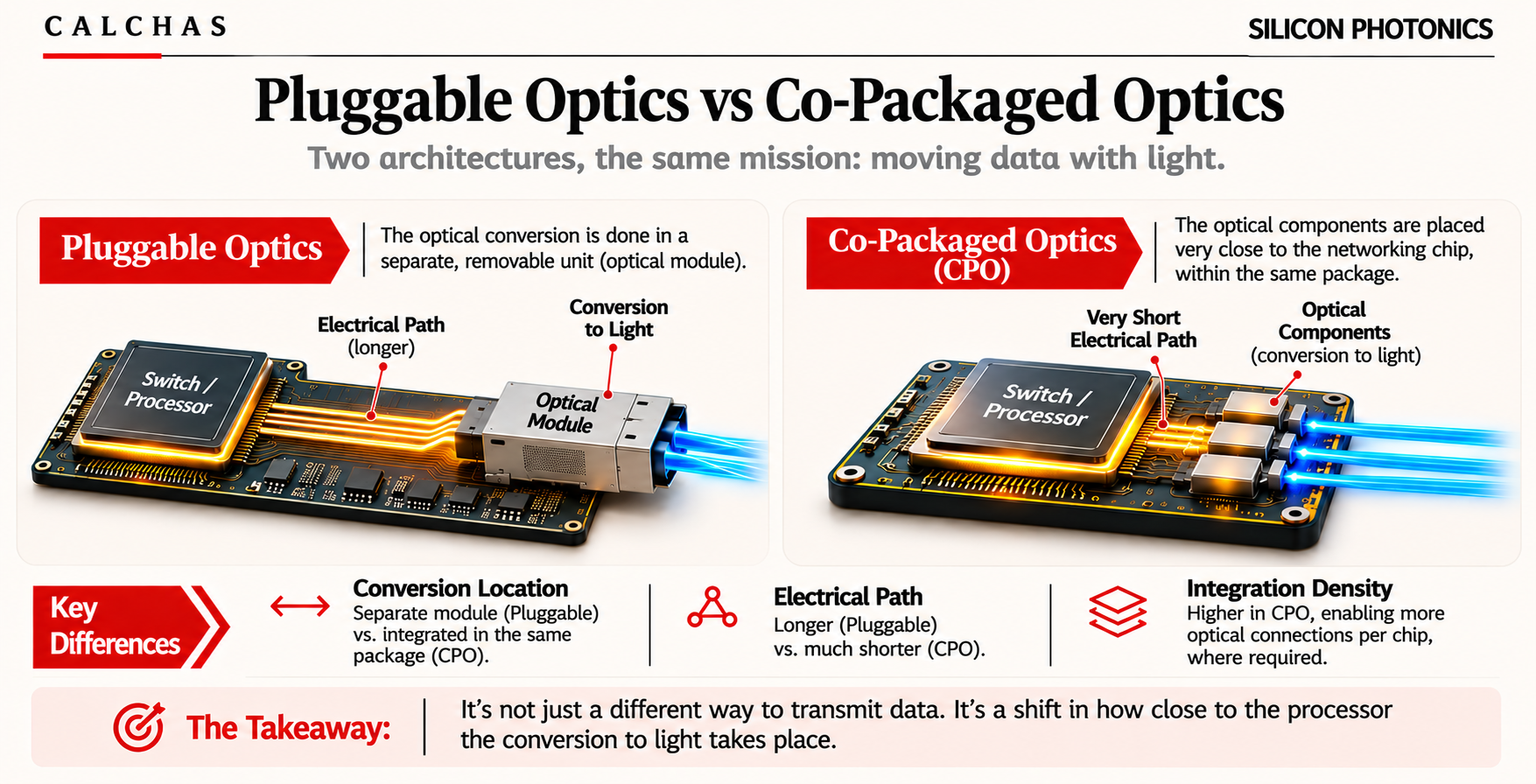
This can reduce electrical signal losses and the energy required for transmission.
The difference is not simply the use of light. It is how close light can reach to the heart of the computing system.
In May 2025, Broadcom announced its third generation of co-packaged optics technology.
In May 2026, NVIDIA announced that its Spectrum-X Ethernet Photonics networking switches had entered production.
According to NVIDIA's technical disclosures, the Spectrum-X Ethernet Photonics architecture can deliver up to five times better power efficiency for the specific networking link compared with conventional pluggable optical transceiver solutions.
This is a company-reported performance claim for a specific technological comparison. It does not mean an entire data center will consume five times less energy.
The essential conclusion is different.
The major transformation is not that we have discovered how to transmit data using light. It is that we are learning to bring light increasingly closer to the processors themselves.
05 / Why It Isn’t That Simple
If transmitting information through light offers such important advantages, why isn't it used everywhere?
Because a technology must do more than perform well in a laboratory.
It must be manufactured at scale, remain reliable for years, and make economic sense.
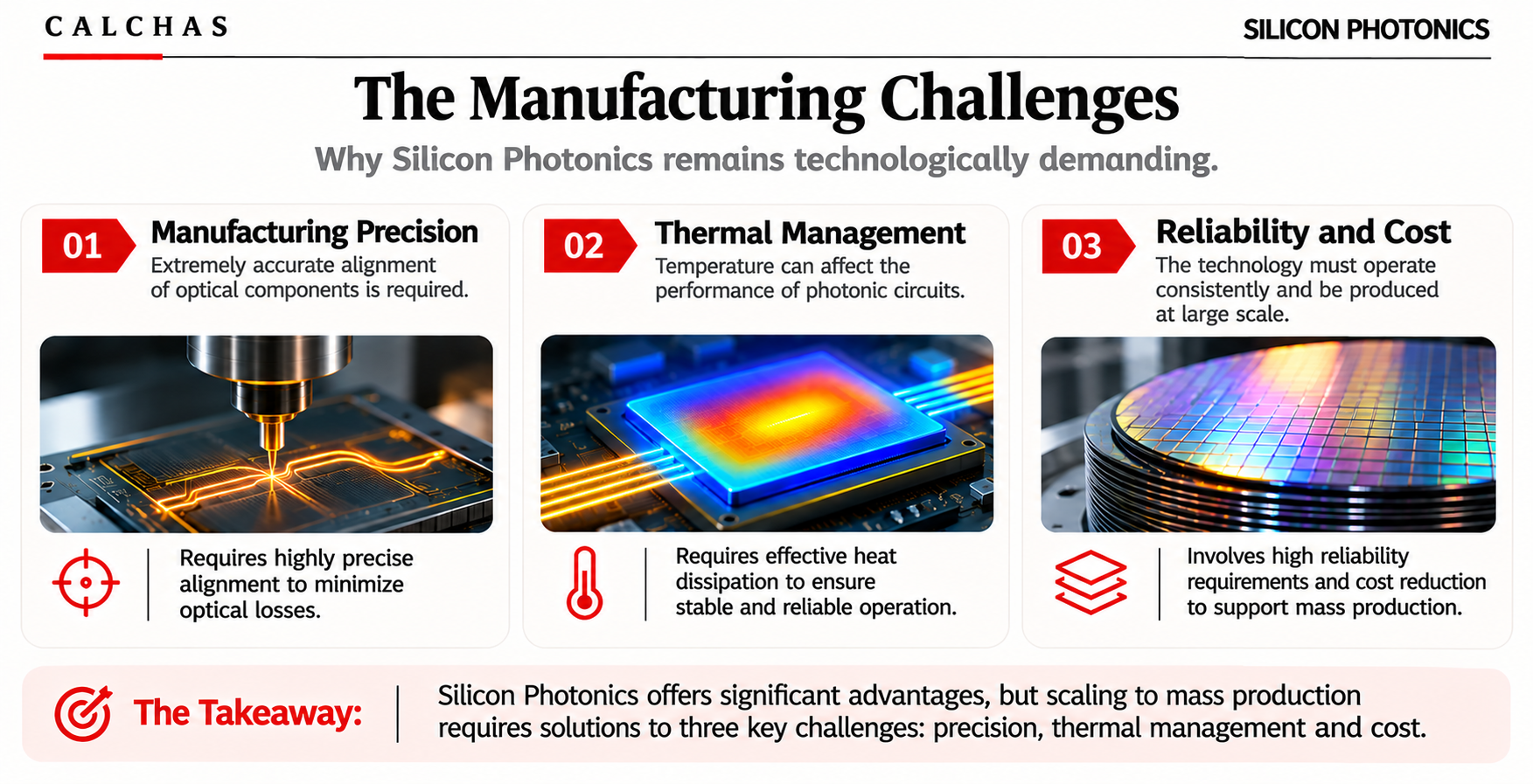
Photonic circuits require extremely precise manufacturing and connections to optical fibers. Even small variations during assembly can affect performance.
Heat presents another challenge.
Powerful processors generate significant amounts of heat. Placing sensitive optical components close to them makes temperature management more complicated.
These challenges remain active areas of research for organizations such as imec and for the semiconductor industry.
Then there is cost.
A new technology may be faster and more energy-efficient while still being more expensive to manufacture or more difficult to maintain.
Companies adopt a solution when its overall benefits justify the costs and risks.
That is why the transition toward optical communication is likely to be gradual.
Electrical and optical technologies will continue to coexist, serving different purposes.
06 / Who Will Capture the Economic Value?
This is where the story becomes particularly interesting for long-term investors.
The development of silicon photonics does not depend on a single company.
It involves an entire ecosystem.
Some companies design the circuits. Others manufacture lasers and optical components. Some develop networking equipment. Others operate the manufacturing facilities required to produce these systems at scale.
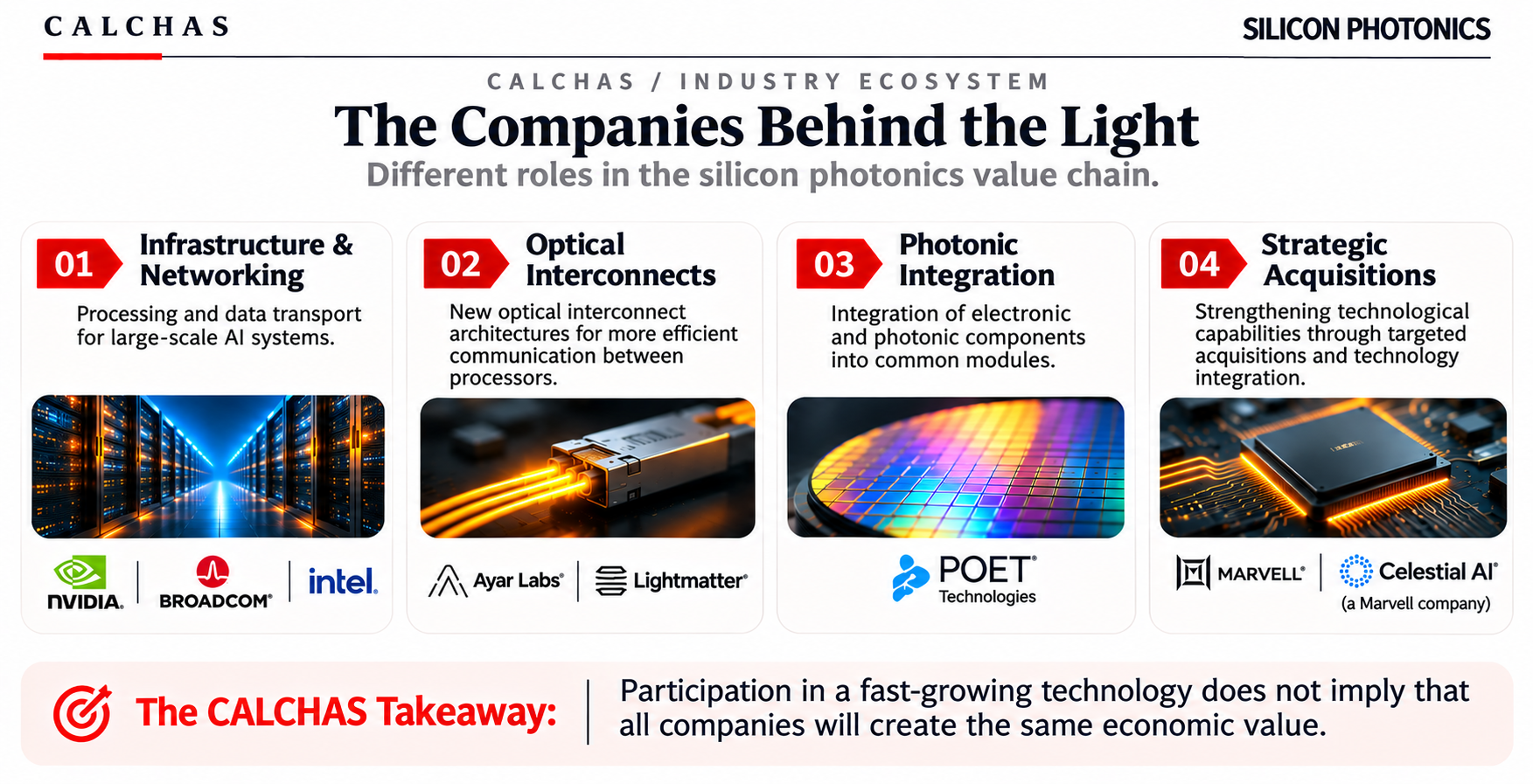
NVIDIA, Broadcom, and Intel participate in different parts of this technological transformation.
But participation in a growing industry does not guarantee financial success.
A company may develop outstanding technology and still face intense competition.
It may increase revenue rapidly while requiring equally significant investments to support that growth.
It may even contribute substantially to an industry's progress without maintaining strong profit margins.
For investors, the essential question is not simply which company has the best technology.
It is which company can turn that technology into sustainable economic value.
Answering that question requires examining competitive advantages, profitability, financing needs, and the price investors are being asked to pay for future growth.
A technological revolution can create enormous value for the economy without generating equally attractive returns for every investor involved.
07 / The Lesser-Known Companies Behind the Transformation
Major technological changes are not created exclusively by the largest corporations.
Often, smaller companies develop specialized technologies that eventually become part of an entire industry's infrastructure.
In silicon photonics, four companies illustrate different approaches.
Ayar Labs, a privately held company, develops optical input/output technology (Optical I/O), enabling processors to communicate using light. It has attracted investment from companies including NVIDIA and AMD.
Lightmatter, also privately held, develops the Passage platform. Its goal is to create dense optical connections that allow large groups of processors to work together more efficiently.
POET Technologies develops its Optical Interposer technology, which enables electronic and photonic components to be integrated into compact modules. The goal is to simplify the manufacturing of optical connections and reduce their cost.
POET is the only publicly traded company among the four and is listed on NASDAQ under the ticker POET. Its commercial execution, financing requirements, and potential shareholder dilution remain critical considerations when evaluating the business as an investment.
Celestial AI developed Photonic Fabric technology to transfer large volumes of data between computing systems. In February 2026, it was acquired by Marvell Technology and is no longer an independent company.
These examples illustrate three possible paths: independent growth, acquisition, or failure to turn technology into a sustainable business.
For long-term investors, the value of following these companies lies in understanding the problems they solve and the competitive advantages they may be able to sustain.
Identifying an important technology is not the same as identifying a good investment.
08 / The CALCHAS Perspective
The history of technology is often told through its most impressive inventions.
More powerful processors. Larger artificial intelligence models. Systems capable of performing increasingly complex tasks.
Yet behind every major technological transformation lies infrastructure that rarely attracts public attention.
Silicon photonics belongs to this category.
It does not necessarily promise a more intelligent processor.
It promises a more efficient way for processors to communicate.
And in a world where computing power is increasingly concentrated in enormous systems, that difference could prove significant.
We do not yet know which architecture will dominate, how quickly adoption will progress, or which companies will capture the greatest economic benefits.
What we do know is that the need for more efficient data transmission is real.
And that major companies are already investing in addressing it.
For long-term investors, this is a reason to observe and investigate. Not a reason to rush.
Because sometimes, the next major transformation is not about what a computer can do.
It is about how computers work together.
CALCHAS is an independent investment research and education platform focused on long-term thinking, disciplined analysis, and understanding businesses beyond market noise.