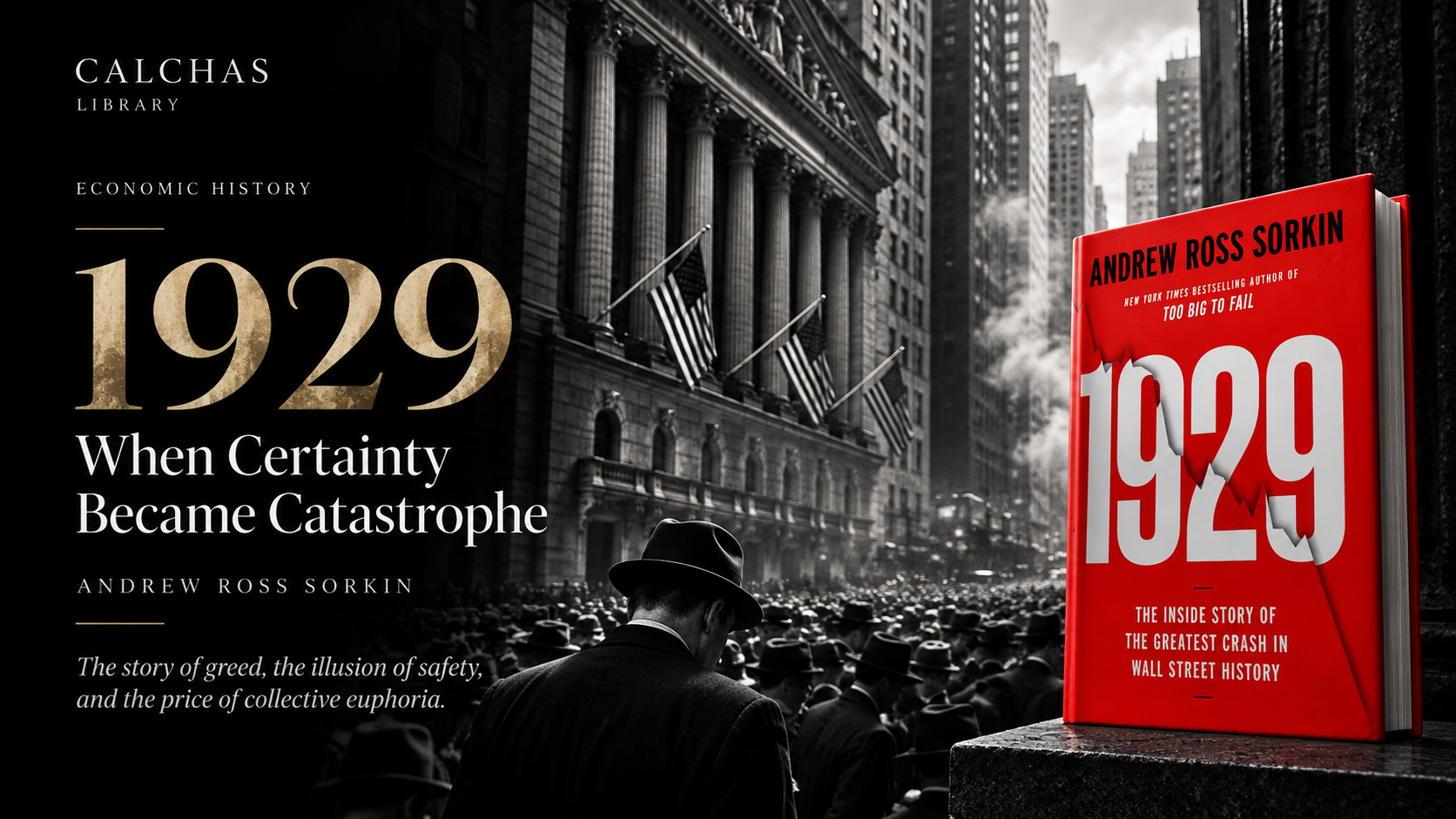
01The Book
1929 went down in history as the year of the great Wall Street crash.
But the catastrophe did not begin on the day stock prices collapsed.
It had begun long before.
In an era of economic prosperity, technological progress, and growing wealth, the belief that markets could rise indefinitely had begun to take hold.
Andrew Ross Sorkin reconstructs this period through the decisions, ambitions, and contradictions of the people at the center of events.
Bankers, investors, politicians, and speculators become part of a story in which economic reality collides with human psychology.
The result is more than an account of a financial crisis.
It is a study of how collective certainty takes shape — and how dangerous it can become.
02Why It Is Worth Reading
The book's greatest value does not lie in its description of the collapse.
It lies in what came before.
Investors did not know they were approaching the end of an era. On the contrary, many believed they were witnessing the beginning of a new one.
Technological progress was real. Economic growth was real. But optimism had begun to turn into certainty.
And certainty into excess.
1929 helps us understand that a strong economy, a revolutionary technology, or an exceptional company does not justify paying any price.
That lesson remains relevant in every era.
03Five Timeless Investment Lessons
01 — Progress Does Not Eliminate Valuation.
A technological revolution can genuinely transform the world. That does not mean every investment associated with it will prove profitable.
02 — Leverage Turns Euphoria into Fragility.
When rising markets are financed by borrowing, an initial decline can trigger forced selling and accelerate a collapse.
03 — Collective Belief Is Not Evidence.
The more people believe that a market cannot decline, the more important it becomes to examine the evidence independently.
04 — Liquidity Becomes Most Valuable When It Is Scarce.
Available capital provides resilience and flexibility when others are forced to act under pressure.
05 — The Greatest Risk May Be the One We Have Stopped Questioning.
Extended periods of prosperity can create the illusion that old risks have disappeared.
04The CALCHAS Perspective
1929 does not teach us to fear the markets.
It teaches us to question certainty.
The long-term investor does not need to predict the next collapse. The task is to recognize risks, preserve independent judgment, and avoid decisions that could permanently destroy capital.
History does not repeat itself in precisely the same way.
Technologies change. Businesses change. Markets evolve.
Human nature, however, changes far more slowly.
And that is why 1929 still matters.
CALCHAS | Final Thought
The greatest excesses are not always born of ignorance.
Sometimes, they emerge when everyone believes they know what comes next.