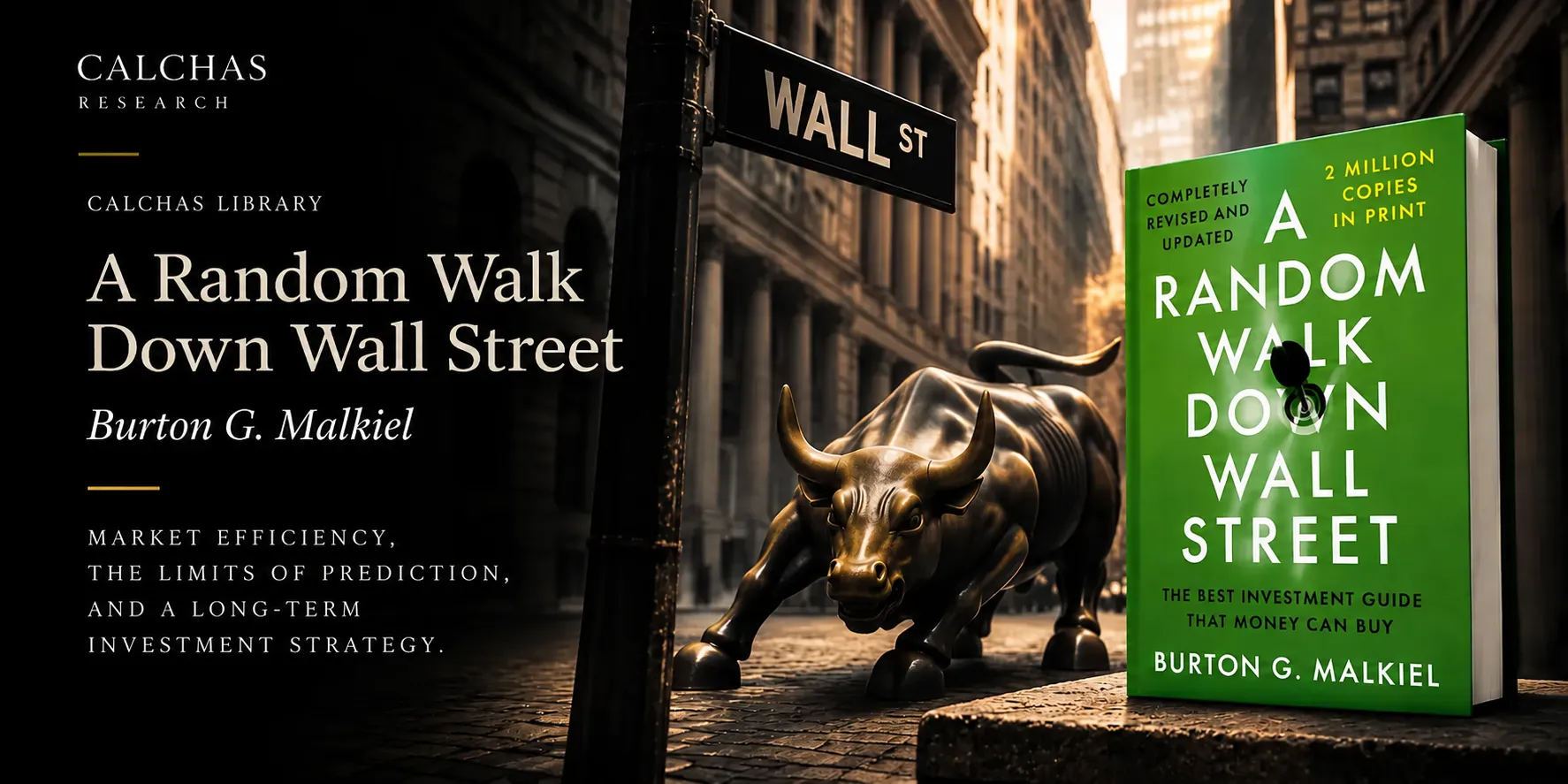
01The Book and Its Significance
Can an investor consistently outperform the market? Or is predicting stock market movements far more difficult than we would like to believe?
This question lies at the heart of A Random Walk Down Wall Street.
When Burton G. Malkiel first published the book in 1973, much of the investment industry rested on the belief that experience, analysis, and stock-picking ability could provide a lasting advantage over the market.
Malkiel challenged that belief.
He did not argue that businesses have no intrinsic value or that financial markets always behave rationally. Instead, he raised a more difficult question: even when an investor identifies an exceptional business, can they know something that has not already been reflected in its share price?
His central argument is that stock prices rapidly incorporate available information. Consequently, future price movements depend largely on new information that cannot be consistently anticipated.
More than fifty years after its original publication, the book remains relevant because it examines a problem that has never disappeared: the difference between investment knowledge and the actual ability to outperform the market.
02The Central Ideas
The Random Walk Theory
The term random walk describes the idea that short-term stock price movements are extremely difficult to predict using their historical patterns.
If available information is already reflected in prices, studying past movements alone cannot reliably produce a lasting investment advantage.
This does not mean that prices move without economic causes. It means that the information driving the next movement is not necessarily known in advance.
Market Efficiency
The efficient market hypothesis provides much of the theoretical foundation for Malkiel's argument.
According to this framework, financial prices incorporate available information so effectively that consistently generating superior risk-adjusted returns, after accounting for costs, becomes exceptionally difficult.
Malkiel does not need to establish that every stock is correctly valued at every moment. His argument requires something more practical: identifying mispriced securities and exploiting those opportunities profitably is neither easy nor reliably repeatable.
Fundamental and Technical Analysis
The book critically examines two traditional approaches to investing.
Technical analysis searches for recurring patterns in price movements and trading volumes.
Fundamental analysis attempts to estimate the economic value of a business through earnings, growth, cash flows, and other financial characteristics.
Malkiel is particularly skeptical of the ability of technical analysis to deliver consistent results. He recognizes the economic logic of fundamental analysis but emphasizes that even careful research can fail when expectations are already reflected in prices or when forecasts prove inaccurate.
Speculative Bubbles and Human Behavior
One of the book's most compelling features is its historical perspective.
Malkiel examines episodes of market enthusiasm in which investors became convinced that traditional valuation principles no longer applied.
These episodes reveal a recurring pattern: a genuine economic transformation can evolve into excessive investment expectations.
The existence of a technological revolution does not mean that every company participating in it represents an attractive investment, regardless of price.
03What Malkiel Argues
Malkiel's central investment conclusion is that most investors would improve their prospects for long-term success by abandoning the continuous search for winning stocks.
His position rests on three observations.
First, financial markets are intensely competitive. Every available piece of information is examined by numerous professionals, analysts, and investors.
Second, active management comes at a cost. Trading commissions, management fees, transaction expenses, and taxes can materially reduce an investor's final returns.
Third, past success does not reliably guarantee future outperformance. Distinguishing genuine investment skill from luck is considerably more difficult than historical performance rankings suggest.
For these reasons, Malkiel advocates broadly diversified, low-cost index funds.
His philosophy does not promise that investors will beat the market. Instead, it offers a way to participate in the market's long-term growth without bearing the costs and demands of constantly attempting to predict its movements.
Diversification, discipline, appropriate asset allocation, and cost control therefore become more important than the search for the next spectacular stock.
04Where Readers May Disagree
Market efficiency is not an unquestionable law of economics.
Behavioral finance has documented systematic human biases, while empirical research has identified recurring patterns in asset returns that are not always easily explained by the simplest efficient-market models.
Furthermore, the process through which prices are formed depends on investors who gather information, analyze businesses, and attempt to identify mispriced securities.
If nobody performed this work, how would information be efficiently incorporated into market prices?
This is a substantial theoretical objection.
The research of Sanford Grossman and Joseph Stiglitz highlighted the paradox of perfectly informationally efficient markets: when acquiring information is costly, there must be some economic incentive for investors to undertake that effort.
Yet the existence of market inefficiencies does not establish that any particular investor can exploit them consistently.
This may be the strongest aspect of Malkiel's argument.
A market can be imperfect and still be extraordinarily difficult to outperform.
05What Long-Term Investors Can Learn
The book's greatest value does not necessarily lie in its recommendation of passive investing. It lies in the intellectual discipline it demands.
Investors must distinguish between the quality of a business and the quality of an investment.
An exceptional company can prove to be a poor investment if its purchase price already reflects excessive expectations.
Investors must also recognize costs as a genuine determinant of long-term returns. Frequent trading, management fees, and unsuccessful attempts to time the market can significantly erode capital.
Above all, they must acknowledge the limits of their own certainty.
A deep understanding of an industry does not automatically translate into an accurate prediction of a stock's future price. Nor does a correct assessment of a company's business prospects guarantee a positive investment return.
Long-term success requires more than good ideas. It demands appropriate risk management, realistic expectations, and the ability to remain invested through unfavorable conditions.
Malkiel reminds readers that an investment process should be designed around their actual capabilities and limitations, rather than their perception of their own abilities.
06The CALCHAS Perspective
A Random Walk Down Wall Street becomes particularly interesting when read alongside the work of Benjamin Graham, Warren Buffett, and Seth Klarman.
Graham approaches a stock as an ownership interest in a real business. Its market price does not necessarily reflect its intrinsic value.
Buffett seeks exceptional businesses with durable competitive advantages, capable of creating value over extended periods.
Klarman places particular emphasis on capital preservation, avoiding permanent losses, and demanding an adequate margin of safety.
Malkiel introduces a different challenge.
Even if these principles are economically sound, how many investors can apply them consistently and achieve better results than a broadly diversified market index?
This question does not invalidate active investing. It does, however, require active investors to justify their approach.
For CALCHAS, the study of individual businesses remains an essential means of understanding economic value.
Analyzing competitive advantages, cash flows, capital structures, and valuations provides the foundation for informed investment decisions.
But this does not mean that every analysis produces an investment advantage.
Nor does it mean that the market will recognize an estimated intrinsic value within the investor's preferred timeframe.
The real challenge is distinguishing between genuine knowledge and a compelling narrative.
Passive investing and the careful selection of individual businesses need not be treated as opposing ideologies.
They represent different responses to the same fundamental problem: how to allocate capital in an uncertain world.
Malkiel reminds us that the market is a formidable opponent.
Graham and Klarman remind us that price matters.
Buffett reminds us that time can work in favor of an exceptional business.
Mature investment thinking must consider all three dimensions.
Why This Book Deserves to Be Read
Because it challenges one of the investor's most dangerous assumptions: that effort, knowledge, and confidence are sufficient to produce superior returns.
It offers no certainty. Instead, it provides a more demanding standard against which to evaluate our decisions.
And that makes it essential reading, even for those who ultimately disagree with its conclusions.