01A Book About How to Think
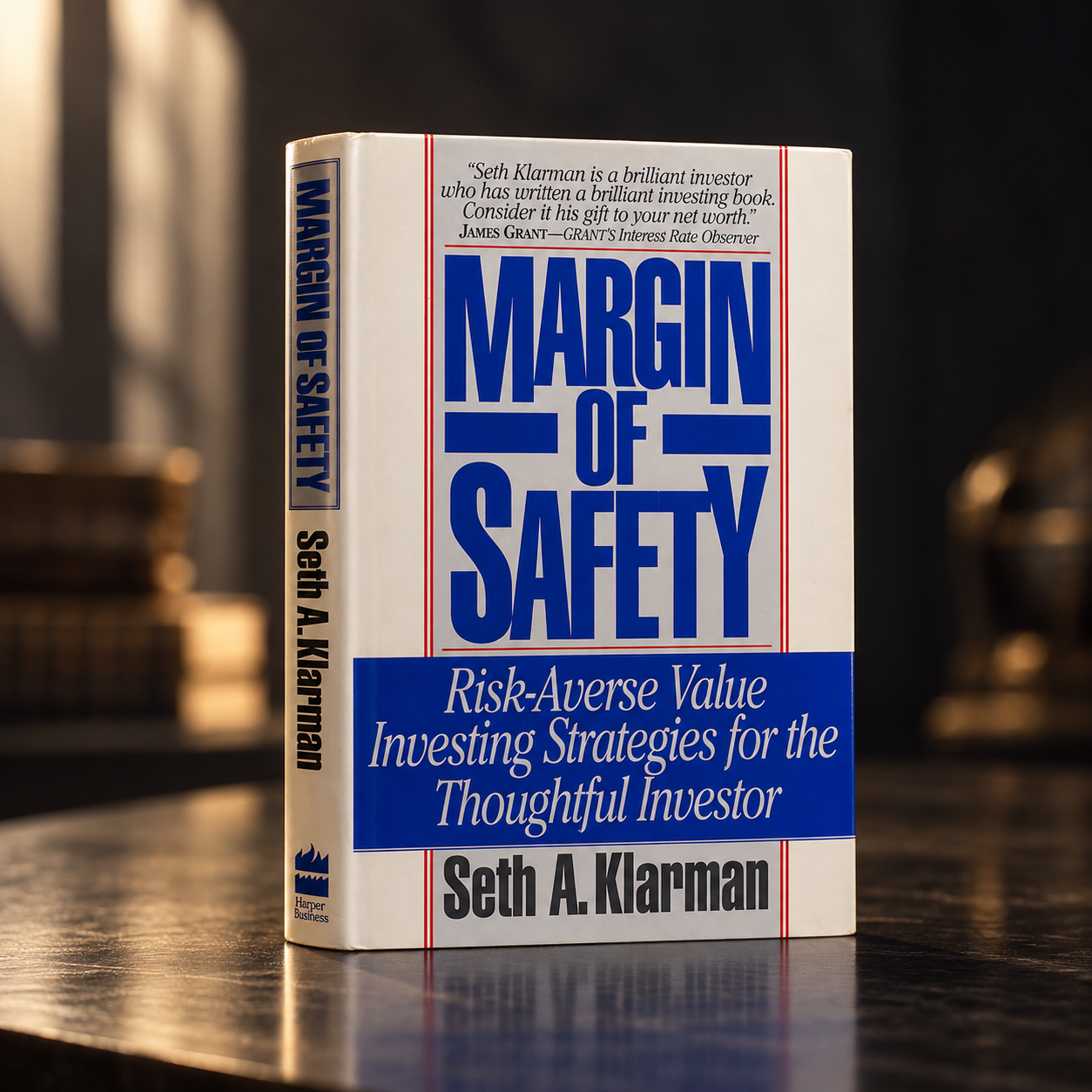
In 1991, Seth Klarman published Margin of Safety: Risk-Averse Value Investing Strategies for the Thoughtful Investor.
He did not attempt to predict the market’s next major advance. He did not present a method for getting rich quickly. Nor did he promise that readers could consistently outperform other investors.
Instead, he chose to begin with something less appealing, but far more important: mistakes.
Why do investors lose money? Why are they swept along by market fashions? Why do even experienced professionals make decisions that run counter to their long-term interests?
Klarman argues that the answer does not lie solely in a lack of knowledge. It lies in how people understand returns, risk, and investing itself.
The book is divided into three parts. The first examines the pitfalls of Wall Street and investor behavior. The second develops the philosophy of value investing. The third applies that philosophy in practice through research, valuation, and portfolio management.
The order is not accidental.
Before learning how to invest, one must understand why so many others fail.
This is the book’s first major contribution: it shifts attention from the search for opportunities to the cultivation of investment judgment.
02Risk Before Return
Most investors begin with one question: how much can I gain?
Klarman proposes the opposite starting point.
How much can I lose? Under what circumstances? And how difficult will it be to recover my capital?
The difference is more profound than it appears.
In financial markets, risk is often described in terms of price volatility. A stock that fluctuates sharply is considered riskier than one whose price follows a steadier path.
For Klarman, however, the more important issue is the possibility of genuine economic loss.
A temporary decline in price does not necessarily amount to a permanent loss of value. Conversely, a stock with a relatively stable price is not necessarily safe if the business behind it is facing serious financial difficulties.
Risk does not reside solely in market movements. It also lies in the quality of the business, its financial structure, the investor’s assumptions, and the price paid.
There is also a mathematical reason for this emphasis.
A loss of 50% requires a subsequent gain of 100% merely to recover the original capital. This asymmetry makes large losses particularly damaging to the long-term accumulation of wealth.
Compounding needs time. Catastrophic losses can erase much of the progress already achieved.
Capital preservation, therefore, is not a rejection of growth.
It is a prerequisite for allowing growth to work over time.
03The Margin of Safety
At the heart of the book lies a principle Klarman inherits from the tradition of Benjamin Graham and David Dodd: the margin of safety.
The basic idea is simple.
An investment becomes attractive when its purchase price is sufficiently below its conservatively estimated value.
That difference provides a measure of protection against analytical errors, unforeseen developments, and overly optimistic assumptions.
The difficulty, however, lies in the word “estimated.”
The intrinsic value of a business does not appear on a stock-market screen. It cannot be calculated with absolute certainty. It depends on future cash flows, competitive conditions, management, the cost of capital, and many other variables.
Moreover, value itself changes.
A business that appears undervalued may remain troubled for years. A large discount in price offers little meaningful protection if the economic value of the business is deteriorating even faster.
The margin of safety, therefore, is not a mechanical formula. Identifying a low market valuation or a low price-to-earnings ratio is not enough.
Investors must understand what they are buying, which assumptions support the valuation, and how resilient their investment position would be if events unfold differently from what they expect.
The margin of safety is a practical acknowledgment of human uncertainty.
It does not require investors to know the future.
It requires them not to behave as though they do.
04Price Is Not Value
A stock’s price is determined every day through trading.
Its economic value depends on the business it represents.
The two concepts are related, but they are not identical.
Markets are influenced by liquidity, expectations, risk appetite, forced selling, and the behavior of institutional investors.
As a result, the same business may be valued very differently at two points in time, even when its economic prospects have not changed to the same extent.
For Klarman, these divergences can create opportunities. Recognizing them, however, requires independent research.
Investors should treat a share as an ownership interest in a real business. They should examine its balance sheet, cash flows, liabilities, and financial resilience.
Simply observing what everyone else is doing is not enough.
This distinction becomes particularly important during periods of enthusiasm. A business may possess exceptional technology, strong management, and considerable growth prospects, while its stock price already reflects excessive expectations.
An exceptional business does not automatically constitute an exceptional investment.
The quality of the business and the price paid to acquire it are two separate judgments.
05Wall Street and Misaligned Incentives
Margin of Safety is not limited to the analysis of businesses.
It also examines the environment in which investment decisions are made.
Klarman describes a Wall Street whose financial incentives do not always align with investors’ interests.
Intermediaries can benefit from increased trading activity. Investment banks can profit from issuing and distributing financial products. Fund managers are often evaluated according to their short-term performance relative to an index or their competitors.
The result is a system that may reward activity more than sound judgment.
An institutional manager may feel compelled to remain fully invested at all times, even when the available opportunities are not particularly attractive.
The manager may also prefer a popular investment held by everyone else because failing alongside the market is professionally easier to manage than failing as a result of an independent decision.
This analysis offers an important reminder.
Investment decisions are influenced not only by data, but also by the incentives of the people making them.
For an individual investor, awareness of these incentives can be an advantage.
Individual investors are not required to publish quarterly returns. They do not need to track an index. They are under no obligation to buy something simply because everyone else is buying it.
They have the ability to wait.
Provided they can withstand that waiting psychologically.
06Patience Is Not Inaction
In the investment world, action is visible.
Patience is not.
A purchase or sale can be presented as the result of research and decisiveness. Holding cash is often perceived as an inability to choose.
Klarman challenges this logic.
Available capital provides flexibility. It enables investors to respond when conditions change and prices create genuine opportunities.
Liquidity, of course, is not without cost. It may result in a loss of purchasing power or in missing part of a prolonged market advance.
Its value lies primarily in the optionality it preserves.
Patience does not mean passivity. It requires continuous observation, research, and reassessment.
It means that investors do not regard themselves as obliged to convert every available euro into a new position.
It also means recognizing that the absence of an attractive opportunity may itself be an important conclusion of the investment process.
07Opportunities Are Often Found Where Others Are Not Looking
In the third part of the book, Klarman examines specific areas in which mispricing may arise.
Corporate reorganizations. Spin-offs. Distressed securities. Bankruptcies. Investments rejected by institutional managers because of restrictions or complexity.
The common element is not a particular category of securities.
It is the existence of circumstances in which price may diverge from value for reasons that are not directly related to the underlying economic fundamentals.
An institutional investor may be forced to sell a security. A corporate restructuring may create an investment situation that is difficult to understand. An asset may be overlooked because it does not fit within the market’s conventional categories.
These situations can offer opportunities to those with the necessary knowledge, patience, and independence.
They do not, however, offer guaranteed profits.
Complexity may conceal genuine risks. A lack of interest may be justified. And an apparently low price may reflect problems the investor has not yet understood.
The lesson is not to seek out everything others avoid.
It is to determine whether that avoidance has created a genuine investment opportunity.
08The Difficult Decision to Sell
Buying an undervalued investment is only the beginning.
An equally difficult question follows: when should an investor sell?
Klarman rejects the idea that an investment should automatically be sold once it reaches a predetermined percentage gain.
The decision should be connected to the underlying value, future prospects, and the alternative opportunities available.
As an investment’s price approaches its estimated value, the original margin of safety narrows. At the same time, the relationship between expected return and the risk assumed may become less attractive.
This does not mean that every increase in price justifies a sale.
The value of the business may also have increased. In addition, selling may entail tax costs, while the alternative investments available may not be superior.
The essential lesson is different.
No investment position should be exempt from reassessment.
Long-term investing is not the same as unconditional holding.
Investors need the patience to allow a sound investment position to develop, but also the intellectual independence to recognize when their original assumptions no longer hold.
Time is an advantage only when accompanied by continuous evaluation.
09What Remains Relevant in 2026
More than three decades after the book was published, the investment world has changed significantly.
Access to information is faster. Transactions take place almost instantaneously. Passive investing has grown to a far greater scale. Technology and intangible assets play a decisive role in the value of many businesses.
Some of the specific investment opportunities Klarman describes are closely connected to the conditions of his era.
His broader philosophy, however, remains relevant.
Investors continue to be influenced by fear and greed. Popular narratives continue to be incorporated into prices. Optimistic forecasts can still produce excessive valuations.
And uncertainty about the future has not disappeared.
This does not mean that every modern investment opportunity should be evaluated using the same methods employed in 1991.
The value of a software company, an artificial intelligence business, or a biotechnology company may depend heavily on future developments that are not adequately reflected in today’s balance sheets.
Valuing such businesses is more difficult.
But no less necessary.
Moreover, actively searching for undervalued securities is not the only rational investment approach. For many individual investors, a broadly diversified, low-cost portfolio may be more appropriate than a continuous effort to select individual securities.
The value of Margin of Safety does not depend on every reader becoming a value investor in the strict sense of the term.
Its principles of discipline, independent thinking, and capital preservation can be applied across different investment strategies.
10The CALCHAS Perspective
CALCHAS is interested in businesses capable of creating disproportionate value over many years.
Artificial intelligence, robotics, energy, biotechnology, and other areas of technological change can create new markets and reshape entire industries.
But identifying a major trend is not the same as identifying a good investment.
A technology can change the world without every investor who financed it making money.
A business may grow impressively while its stock delivers disappointing returns because the original expectations were excessive.
And an investment position may prove mistaken even when the original long-term trend is ultimately confirmed.
This is where our perspective meets Klarman’s.
We do not need to adopt every specific investment choice he has made in order to recognize the importance of his philosophy.
There is, however, an essential distinction.
The financial resilience of a business is not the same as the margin of safety of an investment.
A strong balance sheet, capable management, and a sustainable competitive advantage can reduce business risk. They do not, however, prove that the stock is being purchased at an attractive price.
A margin of safety still requires a sufficient gap between the purchase price and conservatively estimated value.
For high-growth businesses, making this estimate is particularly demanding.
It requires close attention to the size of the potential market, financing needs, competition, the risk of shareholder dilution, and the distinction between demonstrated business activity and future potential.
Above all, it requires us not to treat the optimistic scenario as a certainty.
Some businesses may have exceptional prospects yet fail to offer an adequate margin of safety at their current valuation.
Others may remain deeply speculative, regardless of the scale of their potential return.
Discipline requires us to recognize these differences.
It also requires us to reassess our positions when the facts change, without confusing patience with attachment to an earlier decision.
Conviction must be supported by evidence.
It must not replace evidence.
Margin of Safety does not offer a method for eliminating risk. It offers a framework for thinking that helps us recognize risk, evaluate it, and decide when it is worth assuming.
For the long-term investor, this is one of the most important skills.
Discipline does not guarantee investment success. It does, however, increase the likelihood that we will remain on the journey long enough to pursue it.