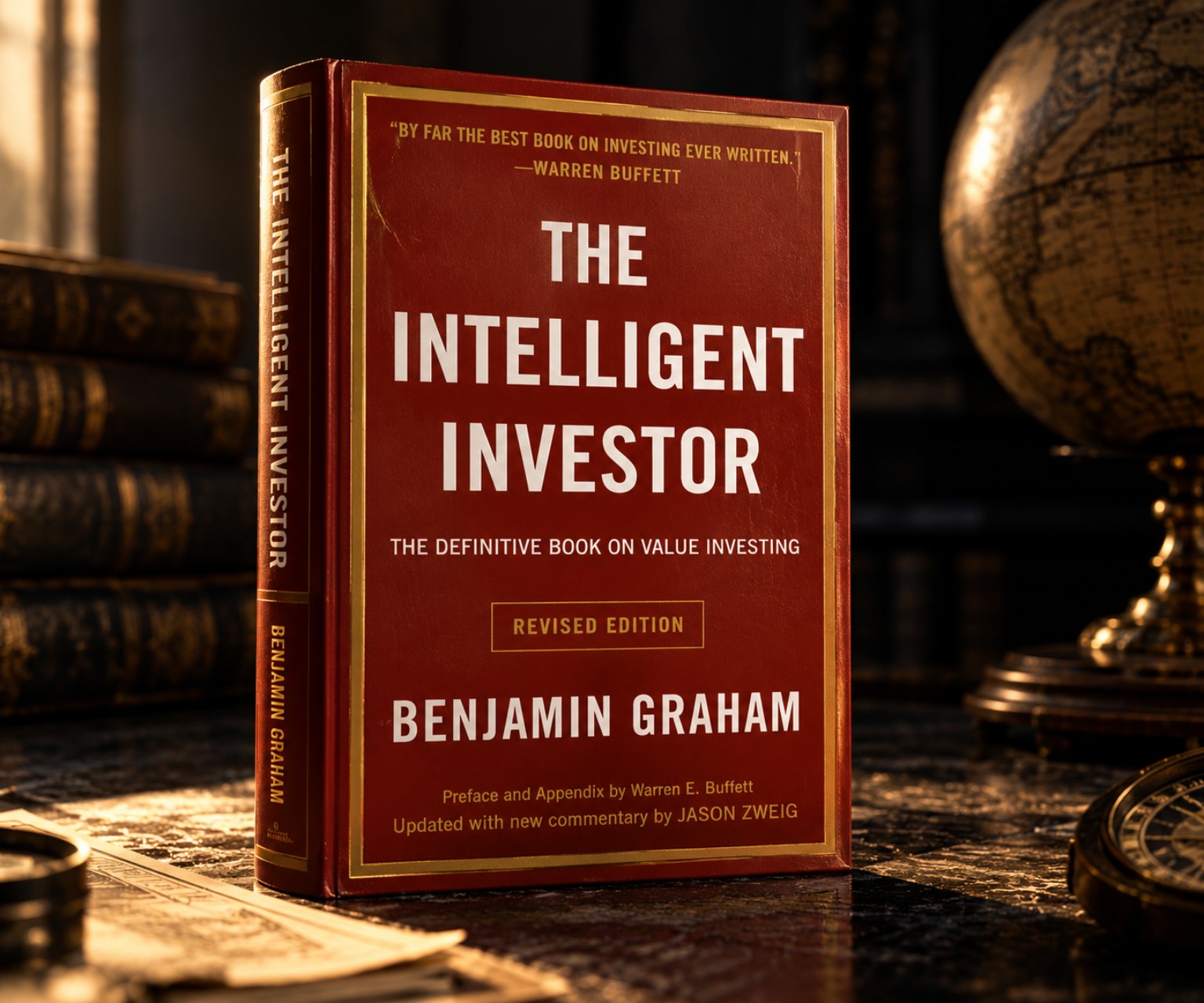
01The Book
What separates an investor from a speculator?
In The Intelligent Investor, Benjamin Graham presents an investment philosophy built on rational judgment, discipline, and the preservation of capital.
The book does not attempt to predict the market's next move. Instead, it explores how investors can make decisions in an uncertain environment without being driven by excitement or fear.
02Why It Is Worth Reading
The Intelligent Investor remains one of the foundational works of investment literature.
Its value does not lie in specific stocks or investment opportunities from another era.
It lies in the principles that shape an investor's thinking and remain relevant even as markets, businesses, and technology evolve.
03Who Should Read It
For those seeking to build a solid foundation in investment thinking.
For investors who want to understand the relationship between value, price, and risk.
And for those looking for a more disciplined approach to market uncertainty.
04What Stood Out to Us
What stood out to us in The Intelligent Investor is that it treats investing primarily as a matter of judgment and behavior.
Graham does not expect readers to know what tomorrow will bring.
He encourages them to develop a way of thinking that allows them to act rationally, even when the market around them behaves irrationally.
05Two Chapters That Stand Out
Chapter 8 — The Investor and Market Fluctuations
Graham introduces one of the most enduring ideas in investment literature: the market may offer prices, but it should never dictate our judgment.
Chapter 20 — “Margin of Safety” as the Central Concept of Investment
A fundamental principle reminding us that even the most careful analysis cannot eliminate uncertainty. Protecting against the possibility of being wrong is an essential part of the investment decision itself.
Together, these two chapters highlight two essential demands of investing: independence from the market and discipline in managing risk.
The CALCHAS Perspective
The market does not require investors to predict the future. It requires them to know how to make decisions when the future remains uncertain.