The Truth No One Wanted to Hear
The Trojan War had entered its tenth year.
Along the shore, where the Achaeans had drawn up their ships, a calamity was spreading through the camp. Warriors were dying. Funeral pyres burned without respite. No one knew how much longer the devastation would continue.
Yet the cause lay not behind the walls of Troy.
It lay within the Achaean camp itself.
Agamemnon, the most powerful of the kings who had sailed against Troy, had insulted Chryses, a priest of Apollo. Chryses had come to the Achaean ships to seek the release of his daughter, Chryseis, offering a generous ransom. Agamemnon not only refused but drove him away with threats.
The priest withdrew and prayed to his god.
Apollo heard him.
Enraged, he descended from Olympus, carrying his silver bow. His arrows brought death into the camp. First they struck the animals, then the men.
For nine days, the plague continued.
On the tenth, Achilles called an assembly of the Achaeans. He proposed that they consult a seer, a priest, or an interpreter of dreams—someone who could explain why Apollo had turned against them.
Then Calchas rose.
He was the son of Thestor, the foremost interpreter of omens among the Achaeans. As Homer tells us, he knew what was, what would be, and what had been before.
Calchas could explain Apollo's anger. But before speaking, he asked Achilles for protection.
It was not the god he feared.
It was the king.
The truth he was about to reveal concerned Agamemnon himself, the man who held the greatest authority in the camp.
Achilles promised that, as long as he lived and looked upon the light of day, no Achaean would lay a hand on Calchas.
Not even Agamemnon.
Only then did the seer speak.
Apollo had not been angered by a neglected sacrifice. His wrath had been provoked by the insult to his priest. To end the plague, Chryseis had to be returned to her father without ransom, and a sacred offering had to be made to the god.
Agamemnon was furious.
He called Calchas a prophet of misfortune and accused him of never foretelling anything favorable for him.
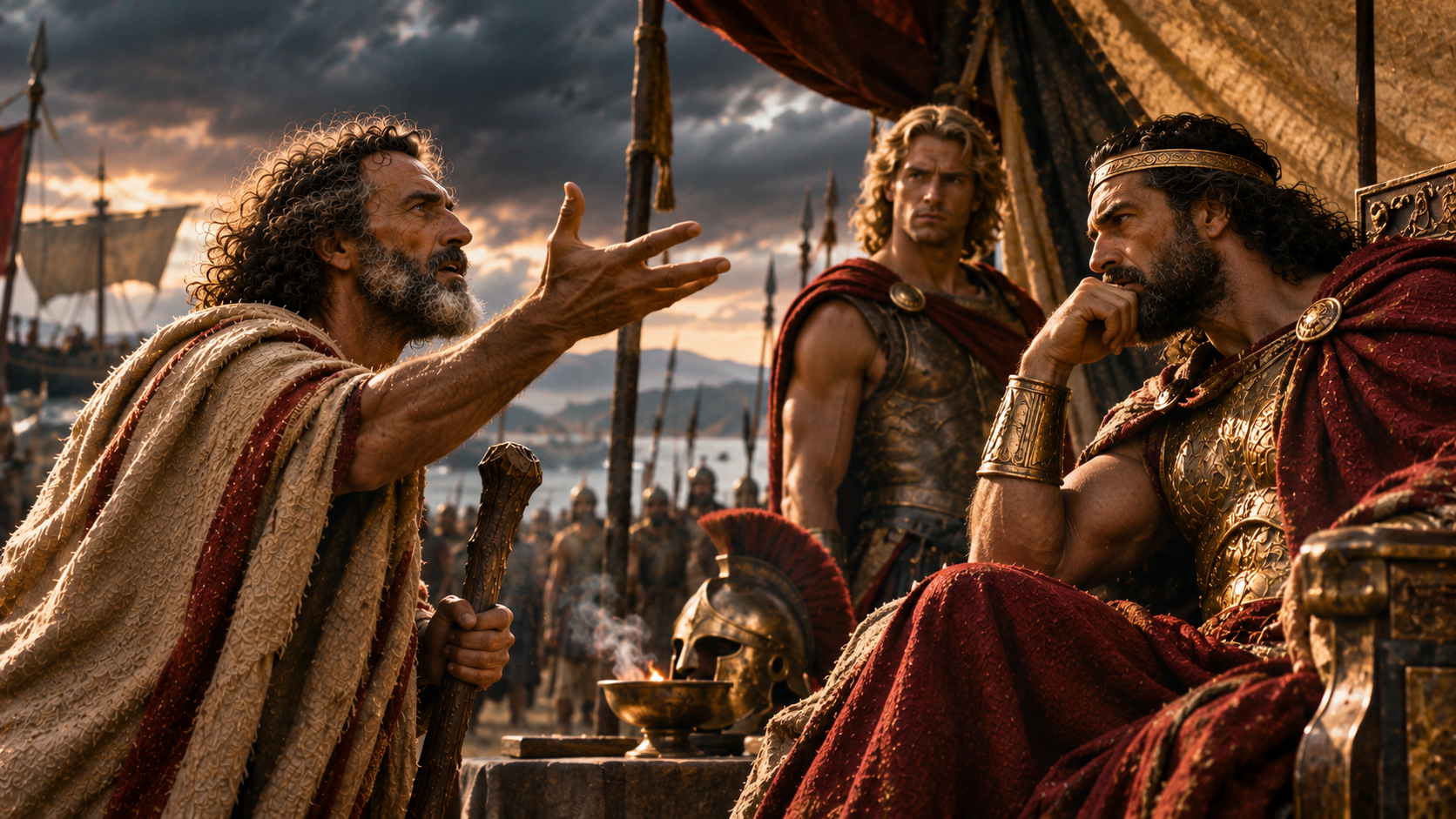
The confrontation that followed would lead to the quarrel between Agamemnon and Achilles—the conflict from which the great narrative of the Iliad unfolds.
Calchas had revealed the cause of the calamity.
But he had no power to impose the remedy.
Such was his position in the world of heroes. He could interpret the will of the gods, yet he had to speak before men who possessed the authority to decide.
And knowledge offered him no protection from their anger.
The Son of Thestor
Before his name became inseparable from Troy, before the Achaean kings sought his counsel, Calchas belonged to a world in which people believed the gods could reveal their will through signs.
The flight of a bird. A dream. An unusual occurrence during a sacrifice.
In the Homeric world, such signs could carry profound religious meaning. But observing them was not enough. One had to know how to interpret them.
This was the art of divination.
And among those who could read omens, Calchas held an exceptional place.
Homer calls him “οἰωνοπόλων ὄχ’ ἄριστος”—the finest among the interpreters of bird omens.
He does not recount Calchas's birth, describe his childhood, or explain how or when he acquired his prophetic gift.
He introduces him as a man whose reputation is already established.
In the opening book of the Iliad, Calchas is described as one who knew the present, the future, and the past.
He was also the man who had guided the Achaean ships to Troy through the prophetic art bestowed upon him by Phoebus Apollo.
That relationship carries particular significance at the beginning of the Iliad.
Apollo was the god of prophecy. But he was also the god of the silver bow, who had descended from Olympus in anger and unleashed his arrows upon the Achaean camp.
His arrows brought death.
And the Achaeans were searching for the cause of their suffering.
The same god who had granted Calchas the ability to interpret divine signs was now the god whose anger he was called upon to explain.
The seer's knowledge did not place him beyond the world of the gods.
It bound him more deeply to it.
A Life That Begins in the Sources
The Iliad does not offer a complete biography of Calchas. Later traditions add details about his origins and family, though they do not always agree.
For the Calchas of Homer, however, two things are clear.
He was the son of Thestor.
And his prophetic art was a gift from Apollo.
Yet his reputation had not been born before the walls of Troy.
One of the most remarkable omens he had interpreted belonged to an earlier moment, when the Achaean army was still preparing to begin its expedition.
At Aulis.
Aulis and the Omen of the Nine Birds
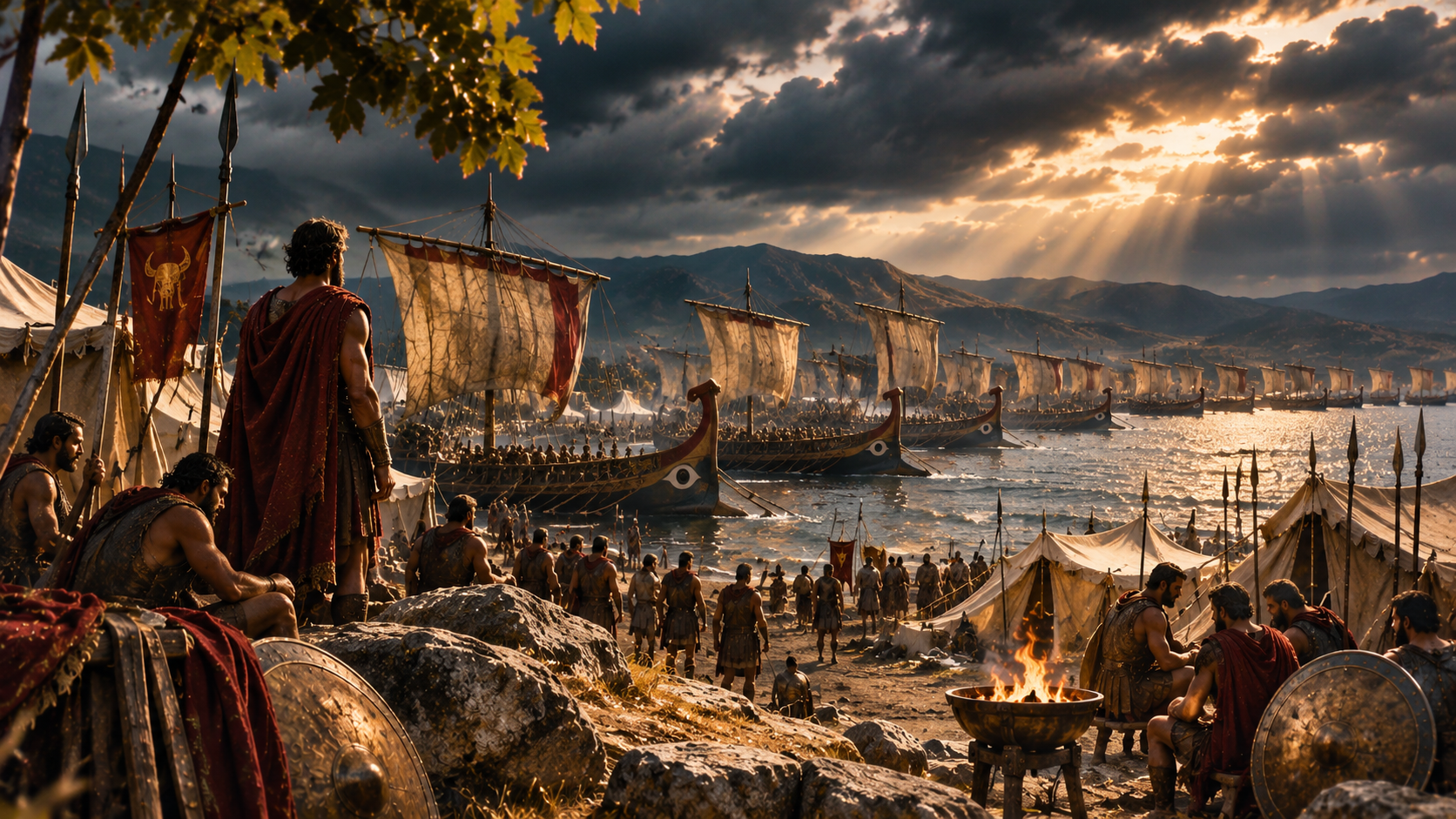
At Aulis, on the coast of Boeotia, the Achaean ships had assembled. Their leaders were preparing to sail against Troy, the distant city to which Paris had taken Helen, the wife of Menelaus.
Before the war had even begun, an extraordinary event had marked the gathering of the army.
We do not hear this story at the moment it takes place. Homer preserves it through the words of Odysseus, who, many years later, recalls before the Achaeans what they had witnessed at Aulis.
It was a memory shared by those who had survived the long years of war.
And at its center stood Calchas.
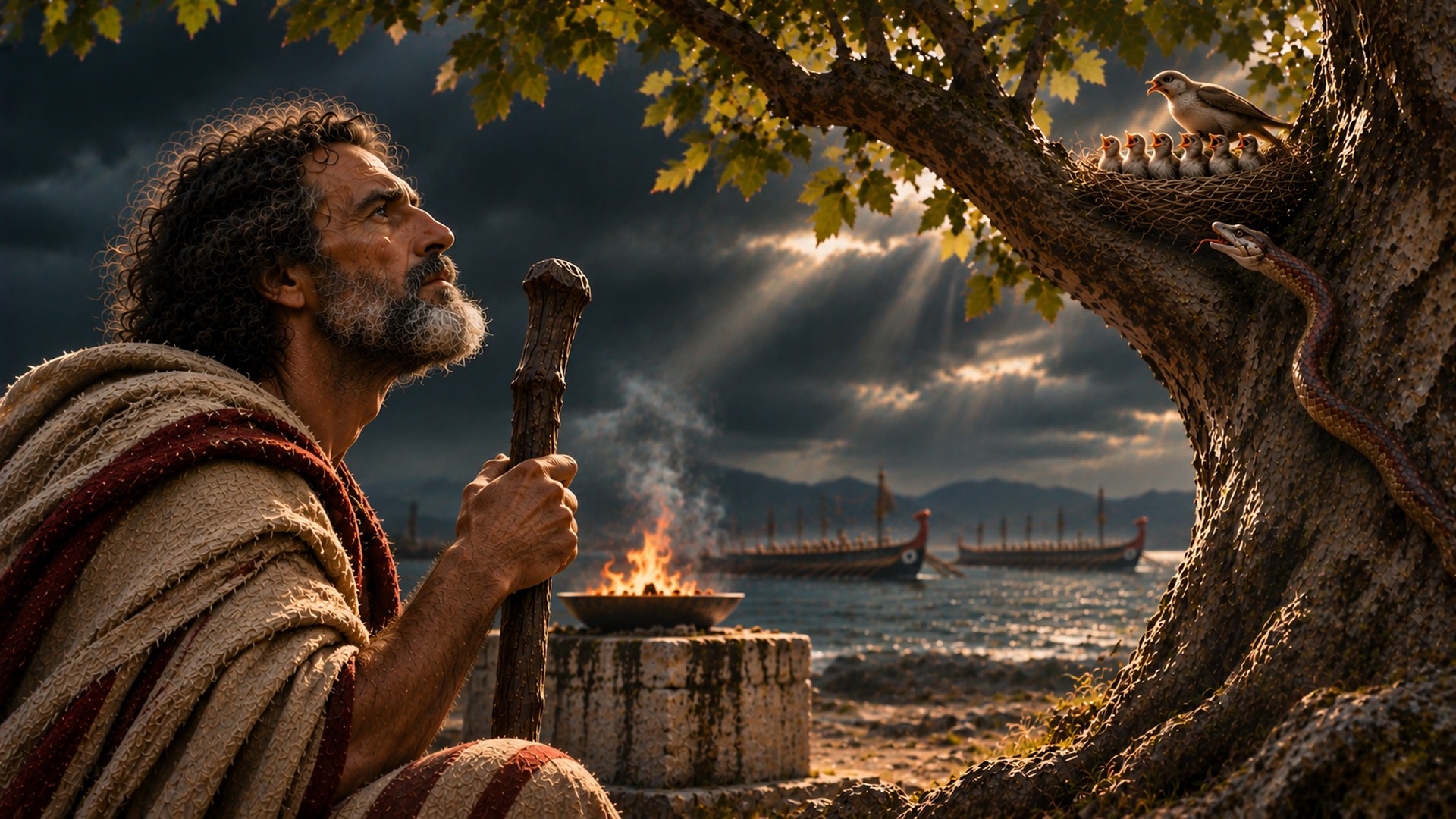
The Serpent Beneath the Plane Tree
The Achaeans were offering sacrifices to the immortal gods beside a spring of clear water. There stood a beautiful plane tree, near the sacred altars.
Then, from the very place of sacrifice, a serpent appeared.
Homer describes it as terrifying, with a reddish hue along its back. According to the epic, this was no ordinary appearance. Zeus himself had brought the creature into the light.
The serpent emerged from beneath the altar and darted toward the tree.
High among its upper branches, hidden beneath the leaves, was a nest containing eight young sparrows. Their mother was the ninth bird.
The serpent climbed the tree and reached the nest. One by one, it devoured the young birds as they cried out.
Their mother flew around the nest, lamenting her young. But the serpent turned upon her as well. It seized her by the wing and swallowed her.
Nine birds had perished.
Eight young sparrows and their mother.
Then, before the eyes of the assembled Achaeans, something even stranger occurred.
The serpent turned to stone.
The same god who had revealed it had now petrified it.
The Achaeans watched in astonishment. At the very place where they had been offering sacrifices, a sign had appeared that none of them could ignore.
The omen had been given.
Its meaning remained to be revealed.
The Interpretation of Calchas
Calchas spoke at once.
He did not treat the event as a strange spectacle, but as a divine sign that demanded interpretation.
Turning to the Achaeans, he asked why they stood silent.
Zeus, he explained, had revealed a great omen. Its fulfillment would be long delayed, but its renown would never perish.
Homer preserves the words:
ὄψιμον ὀψιτέλεστον, ὅου κλέος οὔ ποτ’ ὀλεῖται.
An omen whose fulfillment will come late, but whose renown will never fade.
The eight young birds and their mother numbered nine.
For nine years, the Achaeans would wage war against Troy.
In the tenth, they would capture the city.
That was Calchas's interpretation.
The war they were preparing to begin would not end quickly. It would last for years, and its ultimate outcome, according to the seer, had already been foretold by Zeus.
The prophecy promised neither an easy journey nor victory without loss.
It foretold a long wait.
The Prophecy Put to the Test
Nearly nine years later, Troy still resisted. The Achaean army had grown weary of war, and for many warriors the desire to return home had become stronger than the ambition to conquer the city.
Agamemnon then decided to test the resolve of his men by proposing that they abandon the expedition and return to Greece.
The test produced an unexpected result.
The Achaeans did not recognize the proposal as a stratagem. They rushed toward their ships, ready to depart. The homecoming that had until then been little more than a longing suddenly seemed possible.
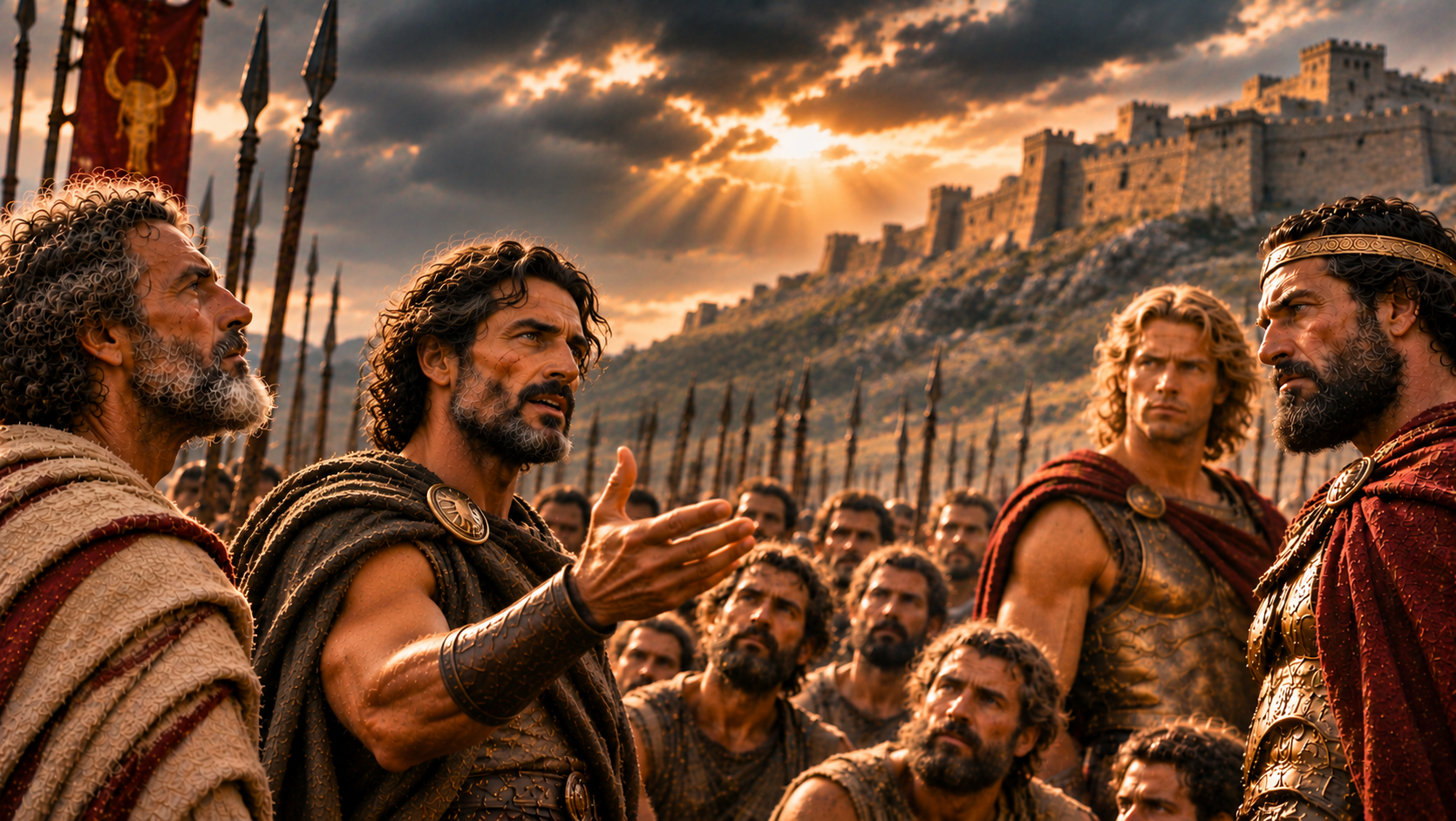
Odysseus intervened to restrain them. Guided by Athena, he sought to restore order and prevent the expedition from collapsing.
When he finally addressed the assembled warriors, he did not simply call upon them to show greater courage.
He asked them to remember.
To return in their minds to Aulis, to the ships gathering for war, to the plane tree and the serpent that had devoured the nine birds.
And, above all, to remember the interpretation of Calchas.
Odysseus did not invoke the prophecy as a truth beyond examination.
He urged the Achaeans to remain a little longer, so that they might discover whether Calchas had truly spoken as a seer.
The seer's credibility now stood before the judgment of time.
Nearly nine years had passed. The city had not fallen. Yet according to the old interpretation, victory had not been promised before the tenth year.
Yesterday and the Day Before
When Odysseus recalls the event at Aulis, he uses a striking expression:
“χθιζά τε καὶ πρωΐζ’.”
Yesterday and the day before.
Nearly nine years had passed since the Achaeans had gathered before the altars. Yet Odysseus speaks of that distant moment as though it belonged to the recent past.
The phrase can be read as a way of narrowing, through memory, the distance between the beginning of the expedition and the present.
What had once been a prophecy about the future had become part of the warriors' lives.
The nine years were no longer merely a number.
They were the years spent far from home. The companions they had lost, the battles they had fought, and the hopes they had postponed.
Calchas had spoken of the duration of a war. The Achaeans had lived through that duration. And now Odysseus called upon them to remain—not because victory had already been achieved, but because the old prophecy had not yet been disproved.
The Man Who Interpreted Time
Calchas had interpreted the sign.
Odysseus now called upon the Achaeans to trust that interpretation.
Between those two moments lay nearly nine years of war.
At Aulis, the prophecy had been a revelation of what was to come. Before the walls of Troy, it had become an argument for continuing the expedition.
Time had transformed its place in the lives of the Achaeans.
What had once been a promise about the future was now an expectation awaiting its final confirmation.
Nine years of war. Victory in the tenth.
The Iliad does not recount the fall of Troy. The epic ends before the city is captured, while the final outcome of the war survives in other ancient narratives.
Thus, the prophecy of Calchas occupies a distinctive place within Homer's work.
The reader hears the promise of victory and watches the Achaeans continue their struggle. Yet its fulfillment lies beyond the boundaries of the Iliad itself.
And Calchas, the man who had interpreted the omen of future victory, is associated in another ancient tradition with a far darker event at Aulis.
A prophecy that no longer concerned the duration of a war.
But the life of a young woman.
Iphigenia.
A Modern Reflection — When Time Tests Conviction
At Aulis, Calchas interpreted an omen. Nearly nine years later, Odysseus urged the Achaeans to wait and discover whether his prophecy was true.
Between those two moments stood time.
And with it, the testing of a conviction.
In Homer's world, the omen was divine in origin. In the world of investing, no analysis possesses such certainty. Every investment thesis rests upon information, estimates, and assumptions that may ultimately prove wrong.
Patience, therefore, is not enough.
An investor may wait years for an original judgment to be vindicated. But the passage of time is not, in itself, evidence that the judgment was correct.
The essential question is different.
Do the facts still support the original thesis?
Long-term thinking requires the ability to distinguish temporary delay from fundamental invalidation. To remain patient when the evidence justifies patience, and to revise our conclusions when that evidence changes.
Calchas belonged to a world in which the future could be revealed by the gods.
The investor lives in a world where the future remains unknown.
And it is precisely this difference that makes discipline indispensable.
Conviction earns its value not by surviving the passage of time, but by surviving scrutiny.
Ancient Sources and Editorial Notes
Primary source: Homer, Iliad.
Book I, lines 8–52 — Chryses, Agamemnon, and the plague.
Book I, lines 53–67 — The assembly and Achilles' proposal.
Book I, lines 68–91 — Calchas and Achilles' promise of protection.
Book I, lines 92–120 — The revelation and Agamemnon's anger.
Book II, lines 73–210 — The testing of the army and Odysseus's initial intervention.
Book II, lines 284–332 — Odysseus's speech and the recollection of the omen.
The omen at Aulis is presented retrospectively through the speech of Odysseus. The Iliad does not narrate the capture of Troy. The reflections on time, prophecy, and the limits of knowledge are editorial interpretations developed for CALCHAS, not verbatim statements by Homer. Iphigenia is not named in the Iliad; her story belongs to other ancient traditions and will be examined in Story 002.
This article is intended for educational and interpretive purposes only. It does not constitute personalized investment advice.