EDITORIAL FRAMEWORK
The story begins with the ancient myth and its different traditions. It then explores the human dilemma and, finally, connects its timeless questions to the thinking of the long-term investor.
Where ancient sources disagree, those differences are acknowledged.
01 / Aulis — The Fleet That Could Not Sail
At Aulis, on the coast of Boeotia, the ships of the Achaeans had assembled. Kings from Mycenae, Sparta, Ithaca and other kingdoms were preparing to sail against Troy. The cause was Helen’s departure with Paris. Warriors had left their homes and were waiting to depart. Yet the fleet could not sail.
The traditions describe the obstacle differently. In Euripides’ Iphigenia at Aulis, the absence of favourable winds keeps the ships in port. In Aeschylus’ Agamemnon, contrary winds from the Strymon hold them fast. In every version, the delay threatens the expedition. The men grow restless. The allies have ambitions of their own. Agamemnon, commander of the Achaeans and king of Mycenae, can command his soldiers, but not the sea.
The Achaeans turn to Calchas, son of Thestor. Homer presents him as a seer who knows what has been, what is, and what is yet to come. He has already interpreted the omen of the birds that foretold the war’s long duration. Now they ask him to explain why the war cannot even begin.
His answer, as preserved in the tragic tradition, is terrible: Artemis demands the sacrifice of Iphigenia, daughter of Agamemnon and Clytemnestra. Not an animal. Not a precious offering. The price is the life of someone who did not choose this expedition and bears no responsibility for the fleet’s confinement.
Calchas reveals what he understands to be a divine demand. But he is not the one who must decide whether it will be fulfilled. Agamemnon faces two choices that seem impossible to reconcile: abandon the expedition or surrender his daughter. The question is no longer when the wind will rise. It is who must pay for the journey to begin.

02 / The Wrath of Artemis — Offence and Punishment
Why did Artemis turn against the fleet? The ancients offered more than one answer. In a tradition associated with the lost Cypria, with Sophocles’ account in Electra and with the Epitome attributed to Apollodorus, Agamemnon kills a deer and boasts that even the goddess herself could not have made a better shot. A hunt becomes an act of arrogance: a mortal measures his skill against a deity.
Apollodorus also preserves another cause, reaching back to Atreus, Agamemnon’s father. Atreus had promised to sacrifice the finest animal in his flocks but failed to honour his vow when a golden-fleeced lamb appeared. This tradition places the calamity within the older, darker history of the House of Atreus. There is no need to force these accounts into one: they offer different explanations for divine anger.
Aeschylus enters the tragedy by another route. Two eagles tear apart a pregnant hare. Calchas recognises in the eagles the two brothers, Agamemnon and Menelaus, and in the omen the future capture of Troy. But Artemis, guardian of wild animals and their young, recoils from the violence. Victory is foretold together with its cost.
The accounts differ in what sets the disaster in motion. Yet they converge on its human consequence: the actions of the powerful transfer the cost to someone who had no voice in their decisions. Agamemnon has authority. Calchas has knowledge of omens. The warriors have weapons. Iphigenia has not yet been heard.
To bring her to Aulis, Agamemnon resorts to deception. He sends Clytemnestra a message saying that their daughter is to marry Achilles. There is no wedding. Achilles has given no consent. And Iphigenia begins her journey believing she is about to begin a new life.
03 / The Wedding That Never Was
Agamemnon does not remain unmoved. At the beginning of Iphigenia at Aulis, Euripides shows him sleepless, writing a letter and reopening it. He regrets his first command. Now he asks Clytemnestra not to come with Iphigenia. The wedding, he writes, must be postponed. He is trying to stop what he himself has set in motion.
The letter never arrives. Menelaus intercepts the elderly servant carrying it and discovers its contents. He accuses his brother of seeking command only to recoil from its cost. Agamemnon responds with a question that the expedition’s ambitions cannot erase: why should his own daughter die for Helen?
The brothers’ confrontation does not end with one simply defeating the other. Menelaus changes his mind. He acknowledges that recovering his wife cannot justify his niece’s death and asks that she be spared. But Agamemnon has begun to fear the army he assembled. He believes that, if the demand for sacrifice becomes known, the Achaeans will turn against him and his family. A decision he might once have reversed now seems beyond his control.
Then comes the news: Iphigenia has already reached Aulis. Clytemnestra and young Orestes are with her. They have travelled for a wedding that will never take place. Iphigenia looks for her father with joy. He knows her arrival makes the lie impossible to sustain. For his daughter, Aulis promises a future. For him, it threatens to extinguish one.

04 / Iphigenia Before Her Father
Iphigenia approaches Agamemnon knowing nothing. She sees not the commander of the Achaeans but the father she has not seen for some time. He tries to conceal his grief. When she asks why he is sad, he speaks of their coming separation. She is thinking of marriage and a new beginning; he is thinking of sacrifice. In Euripides, the same words carry two meanings because only one of them knows the truth.
Clytemnestra asks about the ceremony. Agamemnon tries to persuade her to return to Mycenae, but she refuses to leave her daughter. She wants to stand beside her at the wedding. Her refusal makes the deception even more fragile.
The truth emerges through an unexpected encounter. Achilles approaches the king’s tent to discuss the discontent of the Myrmidons, who demand to know when they will sail. Clytemnestra greets him as her future son-in-law. The hero is bewildered. He knows of no engagement and has never asked to marry Iphigenia.
The elderly servant, who witnessed Agamemnon’s attempt to recall the letter, reveals what he knows. The invitation was a ruse. Iphigenia has come not for marriage but for sacrifice. Clytemnestra realises that her own husband devised the deception. Achilles is furious that his name has been used, but his anger goes beyond an insult to his honour. He promises to try to protect the girl.
The promise offers hope, not certainty. Achilles is a formidable warrior, but he faces an army convinced that its departure depends on the sacrifice. Iphigenia learns that others have decided what will happen to her life. Now she must ask her own father to let her live.
05 / Iphigenia’s Plea
Clytemnestra confronts Agamemnon. She reminds him of their family, the children they have raised and the trust he has destroyed. How can she return to Mycenae if he allows their daughter to die? How will she face Orestes and their other children? And why must Iphigenia pay for an expedition organised because of Helen?
Agamemnon invokes the army, the divine demand and the necessity of departure. Clytemnestra refuses to accept that these things can make the death of a child just. But the hardest moment comes when Iphigenia herself speaks.
In Euripides, the girl says that, if she possessed the voice of Orpheus, she might move even stones. But she has no such power. She can only plead. She reminds her father of the years when she sat on his lap, of childhood promises and tenderness. She asks him to see not a seer’s demand, but his daughter.
She asks for neither wealth nor glory. She asks for life. She wants to go on seeing the sunlight. The world of the dead has nothing to offer a child who has barely begun to live. She brings young Orestes before their father too, though he cannot yet understand what is happening. His presence is not an argument from power. It is a reminder of a family on the brink of destruction.
Agamemnon is not portrayed as a man who desires his daughter’s death. He fears it and mourns it. Nevertheless, he believes he cannot resist the army and the expedition he leads. He leaves without reversing his decision.
Iphigenia has spoken for her right to live. She has not been heard. Clytemnestra still places hope in Achilles, but even his protection has limits. Time is running out. Then Iphigenia, who until that moment has been pleading, speaks again in an entirely different way.

06 / Iphigenia’s Final Decision
The army’s desire to depart has turned to fury. Achilles tries to oppose the sacrifice, but even his own Myrmidons refuse to follow him. Men who once obeyed him now threaten him. He returns to Clytemnestra and insists that he is ready to defend Iphigenia, even by force of arms.
Clytemnestra will not yield. She cannot accept that her daughter is the price of a favourable wind. Then Iphigenia asks them to end their resistance. She does not want Achilles to be killed for her sake, or more blood to be shed within the camp. She declares that she is ready to die.
In Iphigenia at Aulis, the girl now connects her sacrifice with the expedition and the glory of Greece. Her words belong to the political and ideological world of the tragedy. We need not turn them into a timeless moral justification for her death. Her reversal is dramatic precisely because it follows her plea for life.
Her death has already been decided by others.
Her father has accepted the sacrifice. The army demands to sail. Calchas has interpreted the divine will. Her mother cannot secure her rescue, and Achilles would have to fight even his own men. Iphigenia is not being asked to choose between two equally available possibilities. Above all, she can decide how to face a fate imposed upon her by others.
Her stance may be read as courage, an attempt to preserve dignity, or the result of unbearable pressure. These interpretations do not cancel one another out. The tragedy offers no easy answer to the question of how free her final decision truly was.
Achilles admires her courage, but he does not withdraw his promise. He tells her that, if she changes her mind, he will remain ready to help her even at the last moment. She persists. She bids Clytemnestra farewell, asks her to care for Orestes and her sisters, and urges her not to hate Agamemnon. Her mother cannot accept that request so easily.
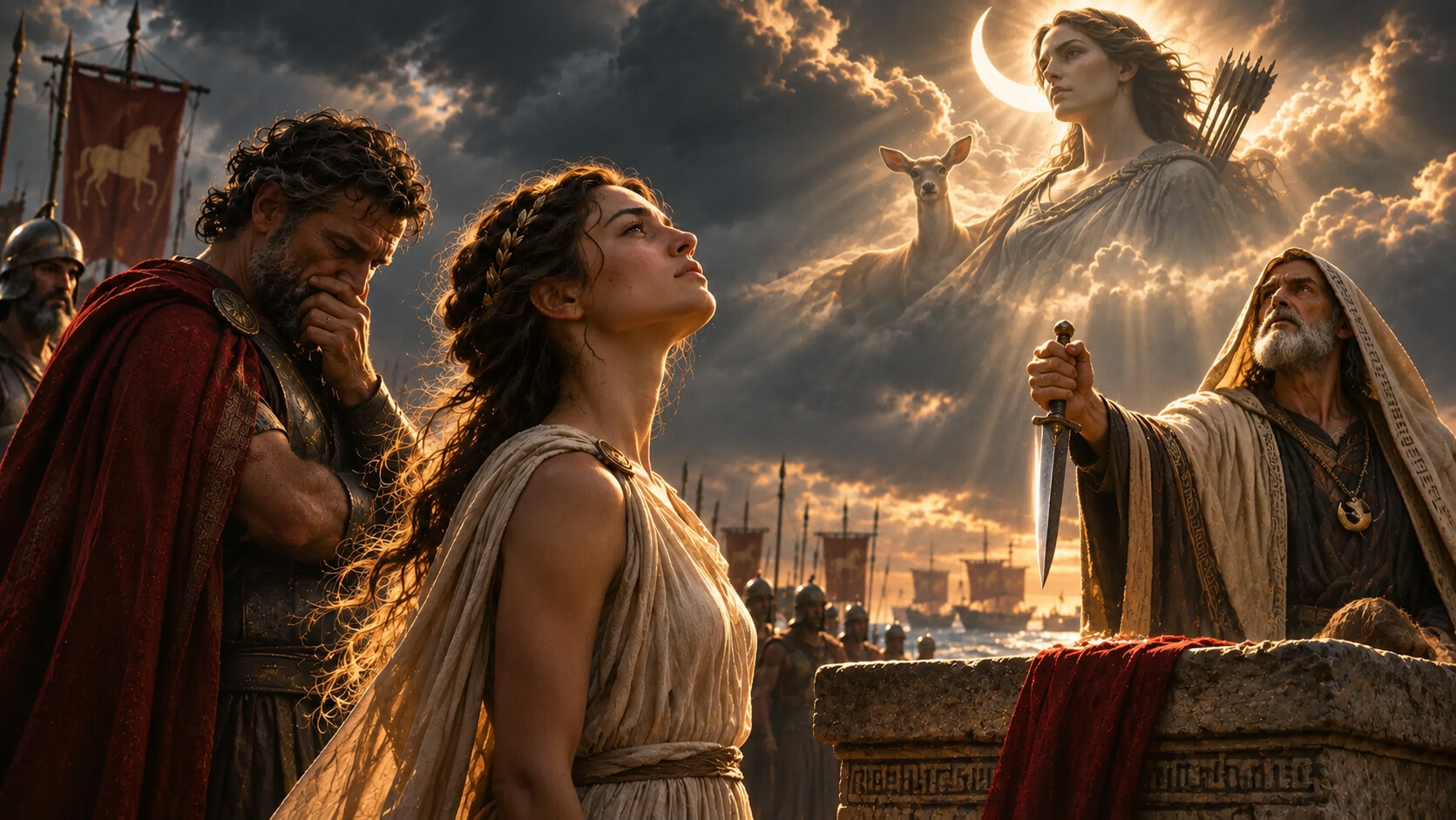
Iphigenia walks towards the altar, unwilling to be dragged there in bonds. The wedding she was promised never existed. Now she tries to give meaning, on her own terms, to what is about to happen. But ancient tradition does not agree on what happened when she arrived.
07 / Sacrifice and Rescue — The Different Traditions
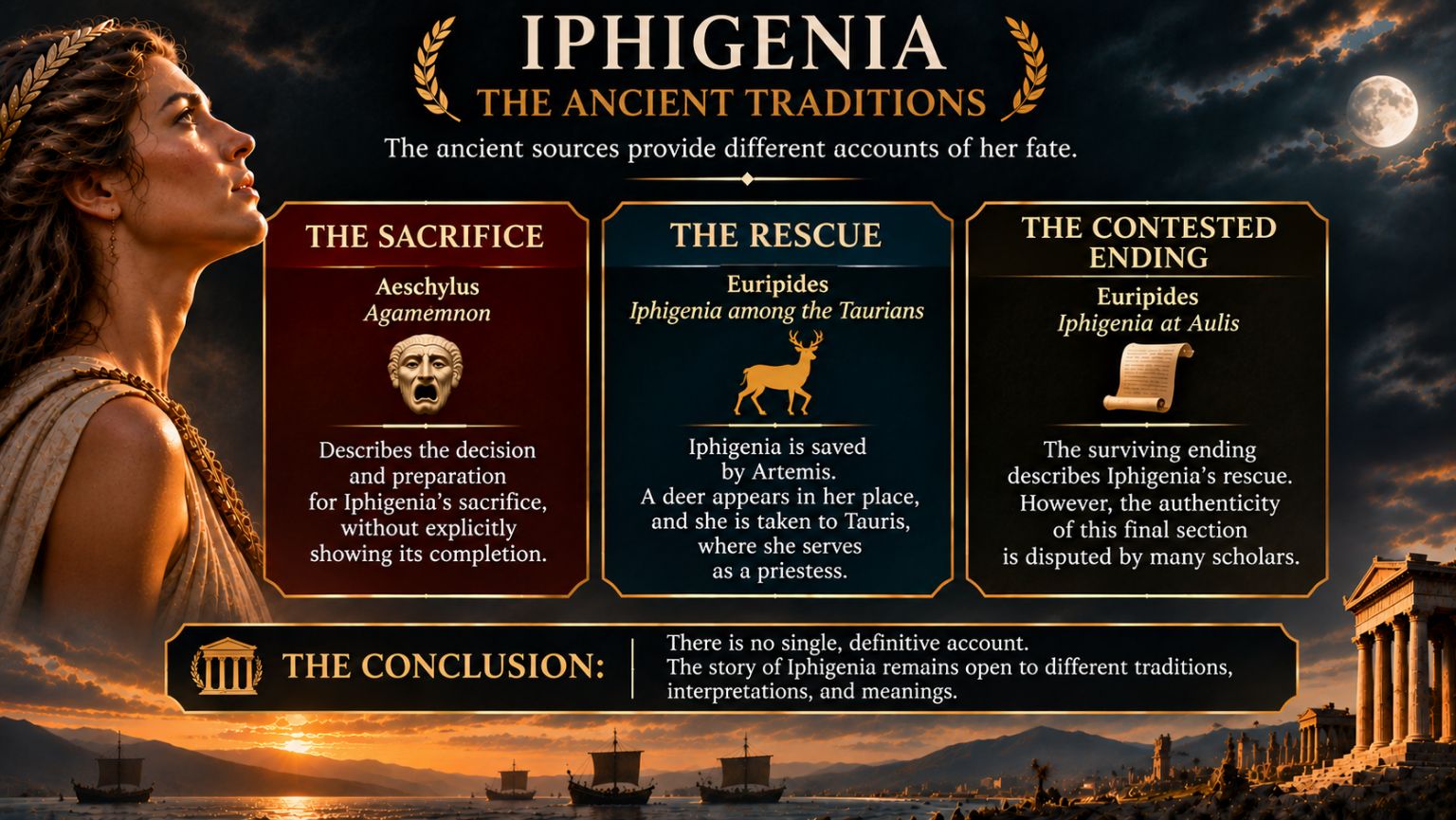
In Aeschylus’ Agamemnon, the image is violent. Iphigenia is not portrayed as willing to die. The men lift her over the altar and gag her so that her cries will not disturb the ritual. The poet recalls how she once sang at her father’s celebrations. The same voice that filled the house with joy is now silenced with his consent. Aeschylus vividly describes the preparations for sacrifice; he does not narrate every detail of the final killing with equal explicitness. The event becomes part of the cycle of violence within the House of Atreus and foreshadows Agamemnon’s return to Mycenae.

Other traditions preserve a different ending. At the last moment, Artemis saves Iphigenia, and a deer appears in her place. The girl is carried far away, to the land of the Taurians on the northern shores of the Black Sea. This version is central to Euripides’ Iphigenia among the Taurians, in which the heroine herself recounts her rescue.
Rescue, however, is not the same as returning home. Iphigenia becomes a priestess of Artemis in a land where strangers are destined for human sacrifice. She has escaped one altar only to serve at another. She does not carry out the final killing herself, but she takes part in the ritual that precedes it. Her life is saved; her freedom is not.
Years later, Orestes reaches the land of the Taurians. He is no longer the small child Iphigenia left behind. In the meantime, Agamemnon has been murdered after his return from Troy, Clytemnestra has been killed by her son, and Orestes is pursued by the consequences of matricide. Iphigenia does not immediately recognise the stranger before her. She risks taking part in a ritual that will lead to her own brother’s death. Their recognition of one another finally opens the way home. But that is another story.
These different versions must not be confused. A narrative in which a deer replaces Iphigenia also survives at the end of Iphigenia at Aulis, but many scholars dispute the authenticity of the play’s final section. The deer need not rest solely on this contested ending: the tradition of Iphigenia’s rescue is attested elsewhere.
Whether Iphigenia is killed or saved by the goddess, human responsibility remains. Agamemnon deceived his family. Clytemnestra believed her daughter was being led to her death. Calchas did not make the royal decision, but his interpretation became part of the chain of events that led to the altar. The winds finally allow the fleet to sail. Yet the fracture within the House of Atreus is not healed by its departure.
08 / A Contemporary Reading — The Price of a Decision
The Cost Already Incurred
Agamemnon had assembled the army, committed himself to his allies and accepted command. The more he had invested in the undertaking, the harder it seemed to stop. The story illuminates the sunk cost fallacy: we continue along a chosen path because we have already invested time, money or reputation in it, even when new evidence calls for reassessment.
An investor may have studied a company for years. That effort does not prove that the original investment thesis still holds. Nor does the purchase price determine the business’s intrinsic value. The question is what the investor knows today and what can reasonably be expected of the future.
The Pressure of Consensus
Agamemnon held power, but he was not independent of others’ expectations. Menelaus, the kings and the army gradually narrowed his ability to question their shared course. In markets, a stock’s relentless rise, analysts’ confidence and the popularity of an idea can create similar pressure. Consensus, however, is not evidence. Independent judgment is tested when there are reasons to disagree with the crowd.
Information Is Not a Decision
Calchas interpreted Artemis’ demand. Agamemnon had the authority to decide. The consequences were not shared equally. For an investor, rigorous analysis can provide knowledge, not transfer responsibility. An analyst does not necessarily know a reader’s time horizon, liquidity needs or tolerance for risk. Research can improve judgment. It cannot replace it.
Necessity and the Value of Reassessment
Agamemnon tried to recall his first letter, yet came to regard his course as unavoidable. In investing, the word “must” often conceals an earlier commitment: I must hold because I bought; I must buy because the price is rising; I must recover a loss quickly. None of these is an investment argument in itself. A thesis must be revisited when the business, its management, its finances or its valuation changes. Discipline is not loyalty to an old estimate. It is loyalty to a process that allows correction.
The Freedom to Make the Next Decision
Iphigenia did not create the circumstances that brought her to the altar. Her acceptance of her fate does not erase how severely her choices had been constrained. Investment losses do not carry the moral weight of human tragedy. There is, nevertheless, a useful distinction: the risks we take today determine how much freedom we will have tomorrow. Excessive leverage, capital that will soon be needed, or concentration in a fragile thesis may force an investor to act when they would prefer to wait. Protecting capital also preserves the ability to choose.
The Destination Does Not Justify Every Path
The Achaeans wanted to reach Troy. But a desirable end does not justify any price. For the long-term investor, building capital can serve independence, security and freedom. A strategy that destroys those very things in the attempt to acquire them has lost its bearings. The destination alone is not enough. What we preserve along the way matters too.
CONCLUSION
The tragedy of Iphigenia lies not only in the sacrifice Artemis demanded. It lies also in the decisions that came before it: in commitments that seemed irreversible, in the pressure of the army, and in a king’s inability to protect what mattered most.
Calchas interpreted the omen. Agamemnon made the decision. Iphigenia bore the consequences.
For the long-term investor, the lesson is not to avoid difficult decisions. It is to preserve independence of judgment and the freedom to change course when the evidence demands it. Research can improve judgment. It cannot replace it.
Before accepting that a price must be paid, we should ask whether it is truly unavoidable — or whether we have simply stopped questioning the path we chose.

ANCIENT SOURCES AND EDITORIAL NOTES
Aeschylus, Agamemnon, especially lines 104–257: the omen of the eagles, the contrary winds and the violent preparations for sacrifice.
Euripides, Iphigenia at Aulis: the letter, the confrontation between the brothers, Iphigenia’s arrival, her plea and her change of mind. The surviving ending, with its account of a deer taking her place, raises well-known questions of authenticity and later revision.
Euripides, Iphigenia among the Taurians: Iphigenia’s rescue by Artemis, her stay among the Taurians and her recognition of Orestes.
Sophocles, Electra, lines 566 ff.: the offence against Artemis during the hunt.
Apollodorus, Epitome, 3.21–22: traditions concerning the deer and Artemis’ anger, as well as the account of Atreus’ vow. The different versions do not constitute a single, undisputed narrative.
Cypria, as summarised by Proclus: the tradition of Aulis and Iphigenia’s sacrifice. The epic itself has not survived intact.
Homer, Iliad, Book 1, lines 69–72, and Book 2, lines 299–330: the identity of Calchas and the omen concerning the expedition’s duration.
Editorial note: This article is a synthesis of ancient literary traditions, not a reconstruction of a single historical event. The contemporary parallels are CALCHAS’ interpretive commentary, not positions advanced by the ancient authors.
Disclaimer: This content is provided solely for educational and informational purposes. It does not constitute personalised investment advice, a recommendation to buy or sell financial instruments, or a promise of returns. Every investment decision requires independent assessment and consideration of individual circumstances.